Leading in a State of Perpetual Motion: The “Transformations as Usual” Mandate
By Steve Garguilo and Maria Vasu
For decades, strategy was something an organization set once a year, or every couple of years, by a small group in a dark room. It was a fixed plan for a world that moved slowly enough to stay predictable. In that era, the baseline was “Business as Usual” – a state of steady operations where transformation was merely a temporary bridge between periods of stability.
That reality is gone.
Today, these are being replaced with Transformation Departments. This fundamental shift in corporate philosophy signals that your competitive edge is no longer a static plan but the speed and grace with which you evolve. Transformation is no longer a side project – it is the strategy and it is the business.

The Myth of the Finish Line
The most dangerous misconception in modern leadership is the belief that transformation has an “after”. Treating strategy as a periodic event creates the illusion of a finish line – a “big bang” rollout with a fixed end date. In a world of simultaneous digital, cultural, and AI shifts, that finish line is a mirage.
Change is no longer sequential. It unfold in interconnected overlapping waves. To navigate this, the traditional roadmap should be replaced by a living document – revised every month or quarter to reflect emerging opportunities. If you are waiting for the “dust to settle” to return to your real work, you have already missed the point. Success now depends on the ability to remain agile and operate effectively within constant flux.
The Permanent State of Flux
In a Transformations as Usual (TaU) environment, we have moved beyond the luxury of “one change at a time”. The new default is a state of perpetual motion where multiple, often conflicting shifts – like AI integration, restructuring, and cultural pivots – collide and overlap. The “steady state” has been replaced by a dynamic equilibrium.
The New Leadership Mandate: Enrollment & Sense-Making
"Command and control” fails in this state of perpetual motion. To navigate the flux, leaders must master two interlinked traits: Enrollment and Sense-making.
Stop Shouting, Start Repeating (Enrollment Mandate)
Transformation fails when communication is treated as a technical “push” rather than an active invitation, neglecting to bring communication on board early or, more importantly, failing to bring employees along for the journey. Town halls and mass emails are often just shouting into a void. True Enrollment – the active choice of an employee to participate – is only achieved when leaders become Chief Repeating Officers. By being active and involving employees in the actual legwork of change, you move beyond “showing and telling” to engaging. You are not just teaching them how to fish. You are making them part of the transformation.
The Leader as a Shock Absorber (Sense-making Mandate)
Being a Chief Repeating Officer requires more than volume. It requires quality of presence. While you may be “swimming for your life” below the surface, your team should not be burdened by that chaos. Your role is to be Sense-maker, translating complex ambiguity into a clear, actionable “why”.
By doing this, you become the organization’s Shock Absorber, filtering the tremors of the market so your team receives only the calm, steady direction they need to execute. This presence answers the paralyzing fear: “Am I going to be here tomorrow?” Without this clarity, you risk losing your best talent to leaders who can provide it. The cost of failing to provide this calm is visible on LinkedIn feeds, where talented professionals post: “Due to the transformation, open to work”. You don’t want your team to be those people, and you don’t want to be the one who drove them there.
New Leadership Mindsets for Constant Change
To thrive in “Transformations as Usual”, leaders must rethink their role. Traditionally, boards seek the steady hand of a profile like Carlos – a legacy leader hired for control and fixed execution. In a stable world, Carlos is an asset. But in an earthquake zone, his rigidity passes friction directly to the team, fueling change fatigue and talent loss.
The modern environment demands a profile like Alex. Alex understands that in a shifting landscape, you need a compass, not a fixed roadmap. Alex prioritizes long-term capacity and acts as a Shock Absorber – processing ambiguity “below the surface” while providing poise and direction above it.
Leading effectively in this reality requires three critical shifts:
1. From Certainty to Curiosity: Trading the “smartest person in the room” persona for the real ability to ask better questions. Admitting you lack a crystal ball opens the door for real-time problem solving.
2. From Control to Capacity: Shifting to building “mental bandwidth”. Leaders do the heavy lifting of sense-making so teams are clear enough on the why to pivot the how.
3. From Launch to Sustain: Treating the “Go-Live” as the beginning, not the finish line. This means investing in the culture and succession planning that bakes transformation into the organization’s DNA and capabilities.
The Pivot of Microsoft’s Satya Nadella is perhaps the most famous example of this shift. Under previous leadership, the focus was often on the certainty of Windows monopoly. When Satya Nadella took over, he famously shifted the culture from "Know-it-alls" to "Learn-it-alls." By prioritizing curiosity and cultural infrastructure over immediate product control, he transformed a stagnant giant into an adaptive powerhouse that provides clarity even in the face of massive AI-driven upheaval.
Explore and dive deeper into these new leadership mindsets. Click here to view our full playbook.
The Opportunity Ahead
For too long, we have treated transformation as a temporary burden to be carried until we reach the “other side”. This friction – waiting for a finish line that doesn't exist – is the true cause of change fatigue. Transformation ceases to be exhausting the moment we stop bracing for an end date and accept that transformation is the new norm.
The move toward “Transformation Departments” we are seeing today is the business world’s way of finally going on the offense. By embracing this new reality, we shift from a defensive posture of “coping” with disruption to an offensive one where the ability to reinvent is our competitive advantage.
To win we need a new set of leadership skills rooted in the “hard work” of Enrollment and Sense-making. This is the essential labor required to filter the noise so you can show up with the poise and clarity your team needs to execute.
Your job is not to lead your team toward a mirage of stability, but to build a resilient organization that thrives precisely because it never stops evolving.
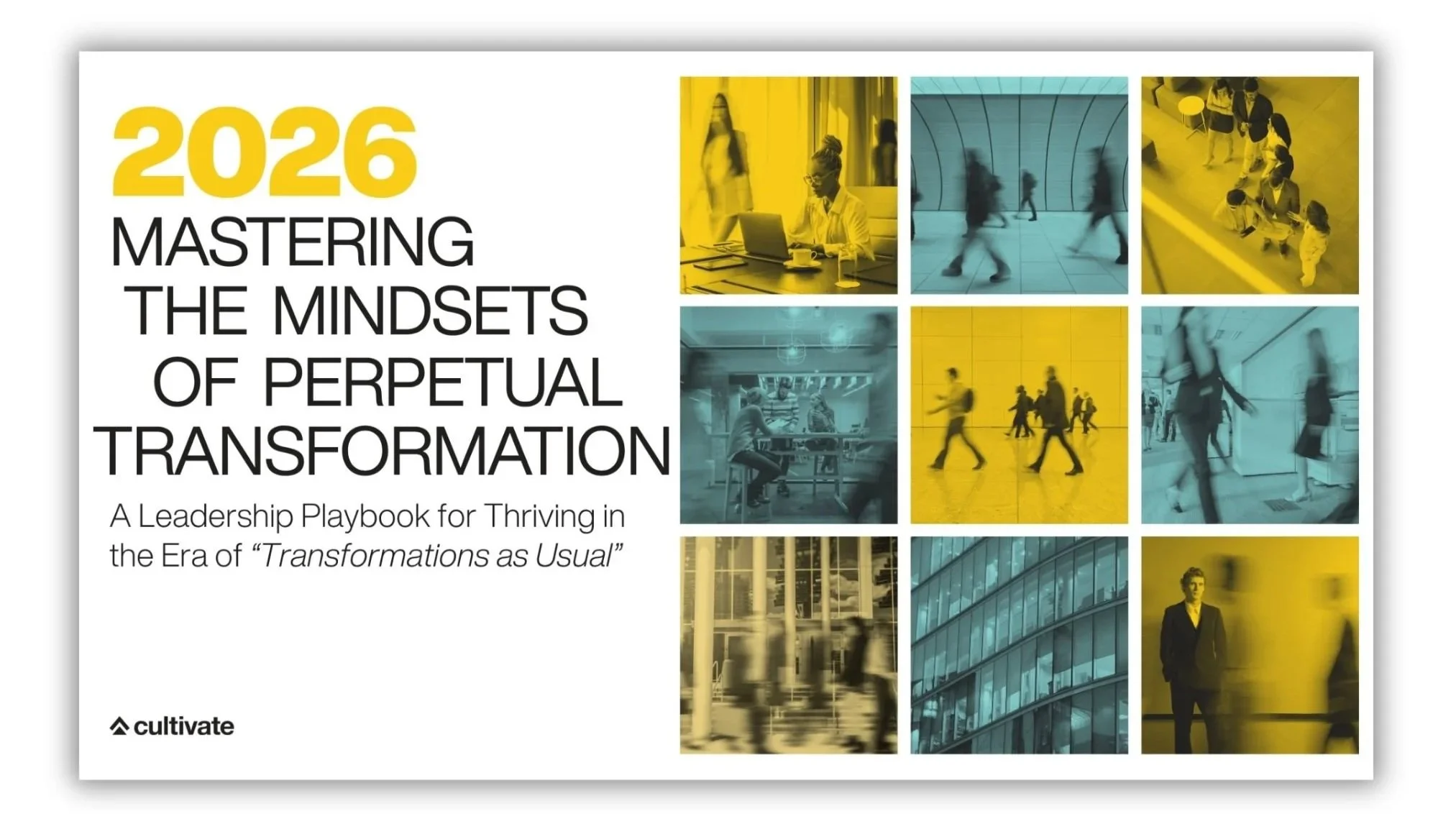
Ready to go deeper? We put together a full playbook with the frameworks, self-assessments, and daily practices behind each of the three mindset shifts. View and download our “Mastering the Mindsets of Perpetual Transformation” playbook to keep going.