Beyond the Steering Wheel: The Business Impact of Autonomous Vehicles on the Future of Work
Nobody who built a railroad was trying to build the steel industry. Nobody at Ford was trying to build the suburbs. People remember the machine, and what came after it is where the real story sits, including for the people who made that same technology.
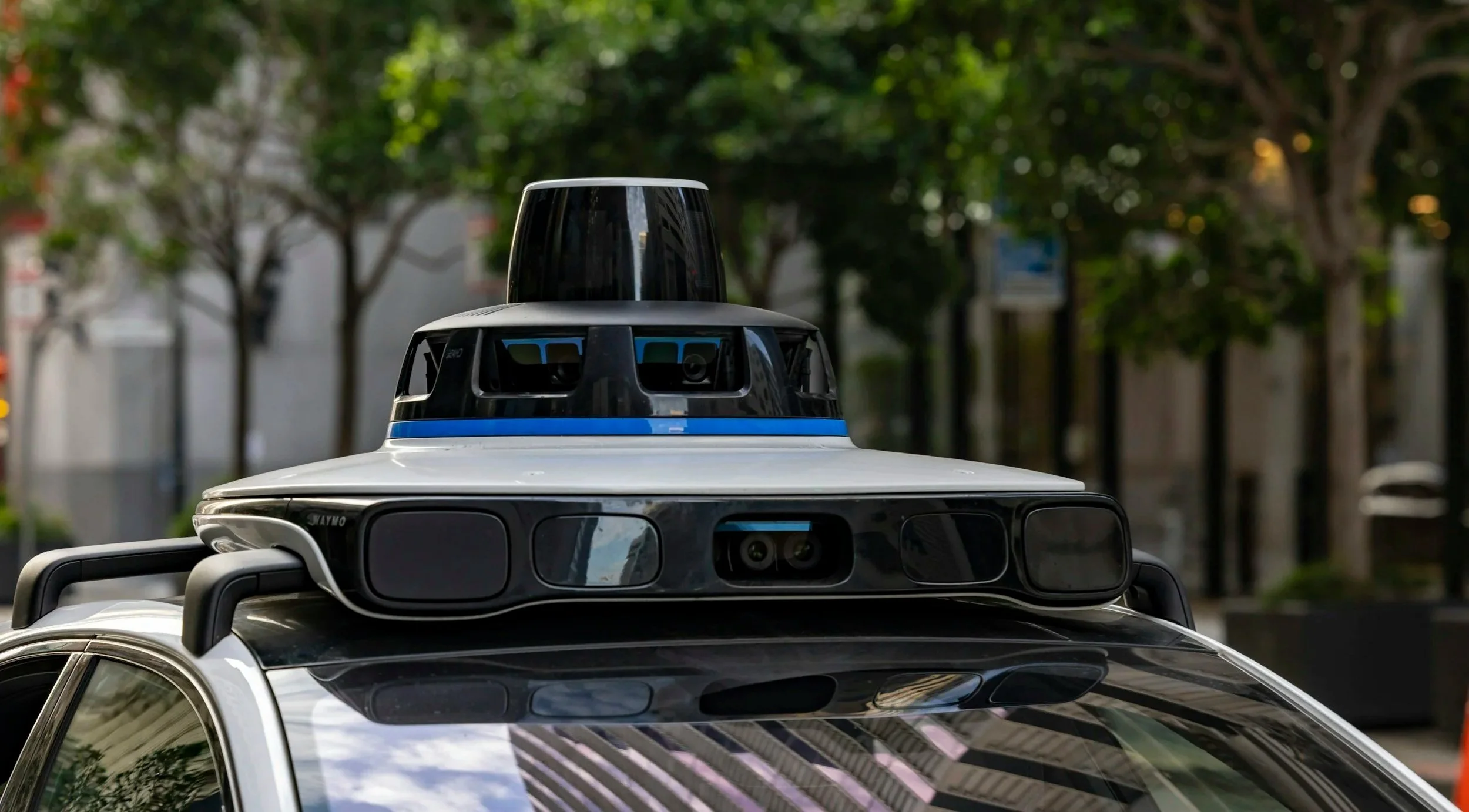
Autonomous vehicles are the newest case, and a full year of commercial data is finally in hand. We’re riding in them now, so what’s next is what the rest of us build around them.
Every Transportation Revolution Created Jobs and Industries Nobody Saw Coming
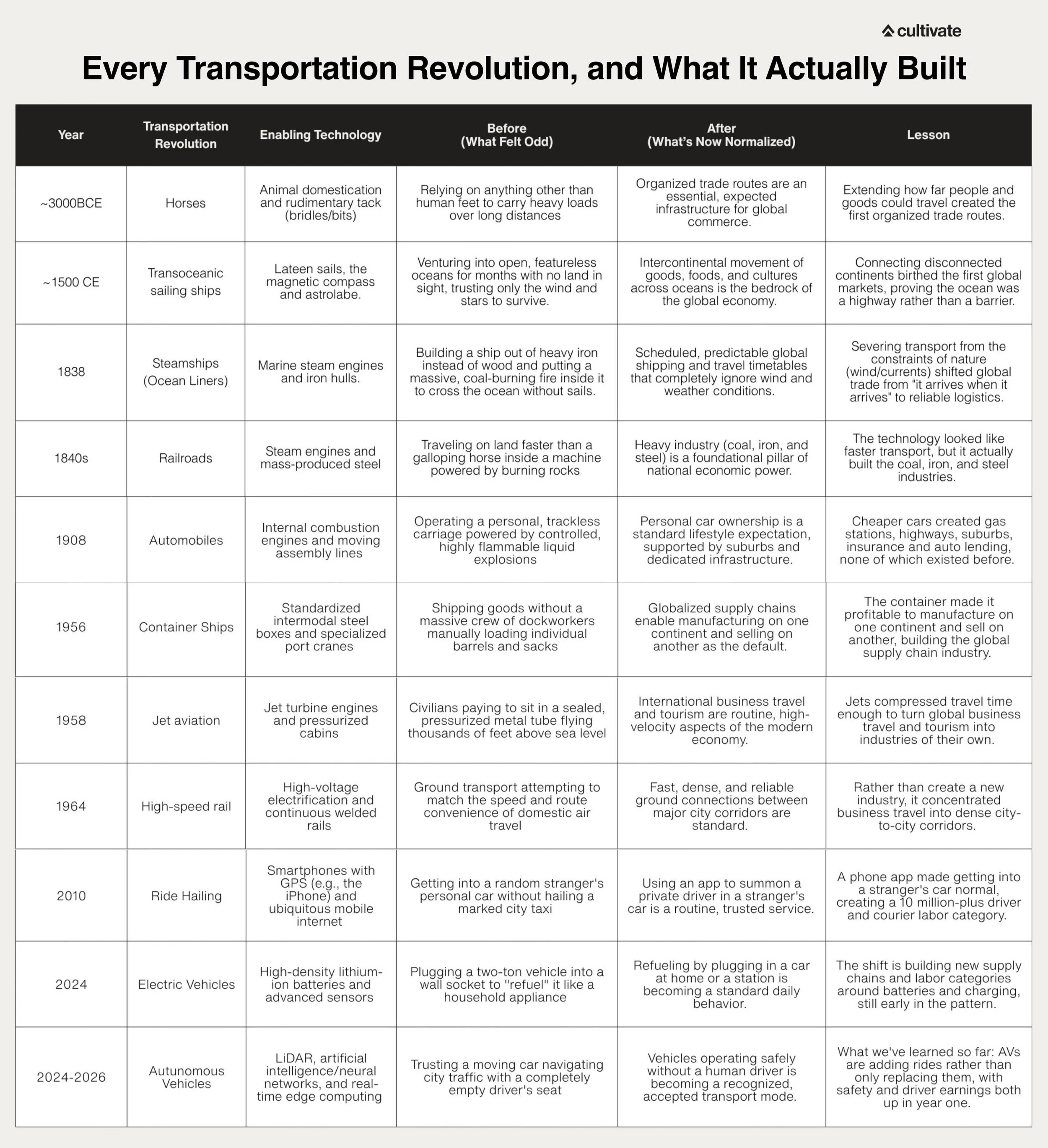
When people started domesticating horses, nobody was thinking about trade routes. They just wanted to reach the next town in a day instead of a week. The routes showed up anyway, and ships carried the same idea across water until a stranger on another continent became somebody you could trade with. Railroads look like a freight story, and what they really did was build the coal, iron and steel industries that grew up around them.
Ford's assembly line dropped the price of a car from $825 to $260 in under two decades, and out came gas stations, highways, suburbs, insurance and a whole lending industry for something that hadn't existed a generation earlier. Aviation turned trips that took weeks into hours and now moves roughly a third of global trade by value.
Not one of those industries had a name before the technology showed up, and the people building it weren't aiming at them.
That pattern didn't stop with the old revolutions. Fifteen years ago, getting into a stranger's car because an app told you to would have sounded reckless, and now it's just how a lot of people get home. UberX arrived in 2012, and the platform now runs more than 10 billion trips a year across 70-plus countries, with more than 10 million people working in a category that didn't exist before.
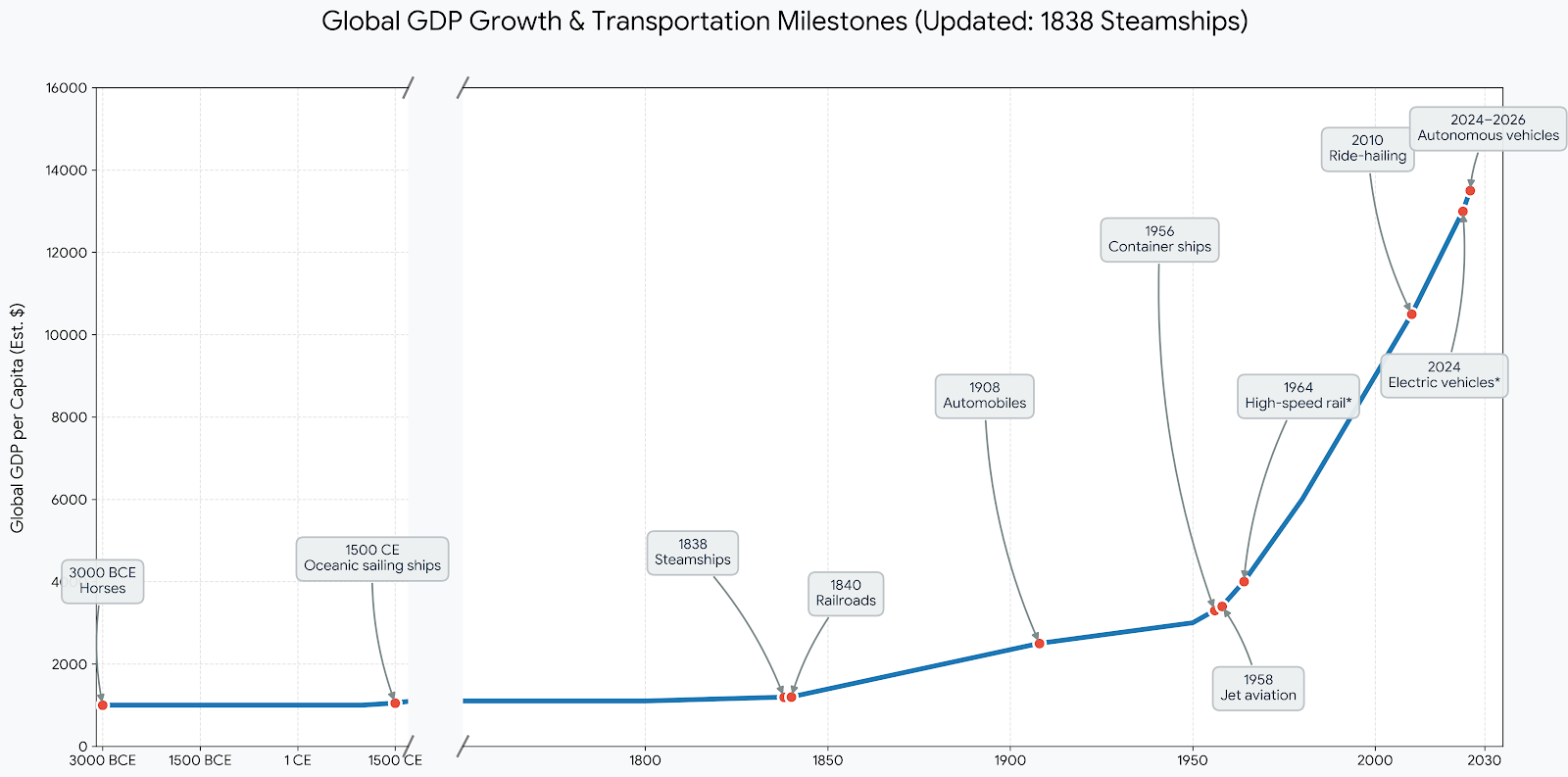
It’s the same sequence every time. A new technology arrives, people change what they're willing to do, and economic activity nobody forecast follows. So what's the activity nobody is predicting yet?
Remarkable, Then Routine
A rider gets into a Waymo in Phoenix and there's nobody in the driver's seat. The wheel turns on its own, and for about two minutes that's the most remarkable thing that's ever happened to them. Then they check their phone.
That arc runs faster than anyone expects, and every transportation revolution has followed it. The open question is whether AVs are running it at scale, and the numbers say they are.
Waymo's paid trips grew tenfold between May 2024 and March 2026, from 50,000 to 500,000 a week across ten US cities. Curiosity turned into habit somewhere in there. It drove 220.6 million miles with nobody in the driver's seat over that stretch, with 94 percent fewer crashes causing serious or fatal injuries than human drivers.
Robotaxis are only half of it. While those passenger miles piled up, freight was quietly proving the same case on the highway. Aurora launched the first commercial driverless truck service on US public roads in May 2025, and its pilot with McLane logged 280,000 autonomous miles at 100 percent on-time delivery before the safety driver came out. Then WattEV ordered 370 Tesla Semi trucks in May 2026, a $100 million commitment and California's largest single electric truck order. And while the Semi only runs driver assist, an order that size tells you how fast operators move once a commercial-volume option exists.
The first year follows the historical pattern. Uber's CEO reported in June 2026 that AVs in Austin and Atlanta are adding rides rather than replacing them, with utilization running more than 30 percent higher there. A year after Waymo launched in San Francisco, the city had 7 percent more taxi and limousine firms and 14 percent more total pay in that category.
The machine took over one job and the market opened doors for more people.
The Trips That Never Happen
Every one of these technologies felt strange before it felt normal. In late 2015, only 15 percent of US adults had used Uber or Lyft and a third of the country had never heard of either, enough of a hesitation that news coverage marveled at a generation raised on "don't get in a car with strangers" now doing it on purpose. By 2024, roughly a quarter of Americans were using these services regularly. It was never only an American shift, either. Motorbike hailing went from informal and a little sketchy to something you book through Gojek in Indonesia or GrabBike in Vietnam, and in the Philippines, formalizing Angkas opened the door for every motorbike app that came after.
People getting comfortable is one half of the story. The other half is price, and that keeps falling.
Remember dial-up? When bandwidth was expensive, we used the internet for email and the occasional website, and we all assumed cheaper bandwidth would just mean the same things arriving faster. Then the price moved and video streaming appeared, a category nobody was asking for at dial-up rates because nobody could imagine paying for it.
A mile works the same way. Right now, a pharmacy won't send a car across town for one prescription, because the driver costs more than the errand is worth. Same goes for a half-empty van of parts, or a lab sample that has to be three towns over by afternoon. None of those trips happen, and nobody notices they aren't happening. Every operation is carrying a list of things it quietly stopped considering, and the list is invisible because the math was never close. So what's on your list?
The money follows the trips that used to be too expensive to run.
A cheaper mile is only worth something if the operation behind it can keep up. Peter Ludwig, co-founder of Applied Intuition, makes the point that a machine can outrun the operation built around it, and when that happens, the operation sets the pace. Hand two companies the same fleet and the results can look nothing alike, because the routing and dispatch already sitting underneath decides how much of it reaches the business. Which is good news, honestly. The advantage goes to whoever has done the unglamorous work of getting ready, and that work is available right now.
The Map Was Drawn for Slow Travel
The people building AVs are solving a transportation problem. What happens to your business depends on what you do once transport stops setting the limit on where people and things go.
Your culture lives in specific places, in the meeting people cross town for, the office they commute to and the site where the work happens. Most of that geography got set when travel was slow and expensive, and it has never been revisited since. Geography is a decision, and most of us inherited ours.
So put a few questions on the table with your team.
If travel between your R&D campus and your plant costs a fraction of today's, does putting all your scientists on one campus still make sense?
If moving a temperature-sensitive sample three sites over costs what moving it next door does, does your web of regional labs still hold, or could fewer specialized sites do the same work?
Which of your team's rituals exist because getting people together used to be hard, and which ones earn their place on their own?
The vehicle was only ever the first constraint. The next one is whether your operating logic, where the labs sit, how samples move, who has to be in the same building, can absorb options it was never designed for. Once the technology works, the bottleneck moves to whoever has to use it.
The work is knowing which of your assumptions were real choices and which were just the cost of a mile. You can answer that this quarter, with the people already in the room, before the cost curve answers it for you.
Key Takeaways:
Every transportation revolution created job categories and industries nobody saw coming, not even the people building the technology behind it.
New technology feels remarkable right up until it becomes routine, and a full year of commercial AV data shows that pattern holding.
The pipeline runs far past ride-hailing, and the real impact will come from what people and businesses do once human-operated transport stops being the constraint.