Onboarding Is the First Thing Your Culture Says Out Loud

Most people can remember exactly how they were welcomed into a company. There's a first week, maybe a first month, a schedule of sessions, and a checklist that runs through someone's opening stretch and gets marked complete somewhere around the ninety-day mark. By every visible measure, the person has been onboarded, and the company moves on.
Come back to that same person months later and ask what the company really values, or who genuinely depends on their work, or whether it feels safe to ask an obvious question in a meeting without looking foolish. A lot of the time, they still can't answer. The program ran exactly as designed, but the person still hasn't really been brought inside the place. And usually, it's the latter that lasts.
Culture is what you believe you're allowed to do.
Culture is what you believe you're allowed to do. It's the sense each person carries about what's welcome here and what will earn them a raised eyebrow, and nobody hands you that in a values deck. New hires absorb it, and they start absorbing it the moment they say yes, well before their first day. That makes onboarding the first thing your culture ever says out loud. Whether intentional or not, it tells every new person what they can and can't do here.
Which means the question was never whether your program covered everything, but it's what all of it is teaching this person about how you work. Most organizations are confident they onboard people well, but Gallup finds that only 12% of employees strongly agree their organization does a great job of it. What most companies might be running is closer to a performance of it, complete on paper but hollow in practice. And the fix is to treat those early weeks as an intentional, ongoing act of culture rather than a stretch you finish and close out.
The Experience Starts the Moment Someone Says Yes
Contrary to what has been the norm, onboarding doesn't start on day one. It starts the moment someone hits accept on that offer. At most companies, though, the stretch between signing and starting is dead air, which we like to call ghost period. In fact, according to Talentech and Vlerick Business School, 64% of new hires report not receiving any preboarding communication. When that window is used well, like when a manager reaches out just to say they’re glad or when a note gets delivered unexpectedly to say they’re expected, a person walks in the first time feeling like they belong there. When it stays silent, they walk in as guests, still deciding whether they belong.
A lot of it comes down to the manager, more than the new hire. If the manager isn't ready to receive someone, the whole experience is mostly decided before it starts. A study showed that active manager involvement makes new hires 3.4x more likely to call onboarding exceptional. In addition, Google's five-point manager checklist (role discussion, peer buddy, network-building help, monthly check-ins for six months, open dialogue), sent as a Sunday-night nudge, made new hires fully effective 25% faster.
Even the smallest gestures carry real weight here. A manager who finds a visible, slightly silly way to keep a new person top of mind for the entire team is doing something more useful than another slide about company history. It keeps that person from vanishing into the crowd during their first weeks, which is exactly when vanishing is easiest.
The power that physical objects have is almost always underrated. As more of work moves onto screens, a tangible object holds a kind of weight that a message in a channel never quite does. And it’s not the branded water bottle or tote bag. People remember the place that handed them something real on the way in.
You're Bringing Someone Into a Company, Not a Team
Here is where a lot of well-intentioned onboarding goes sideways. Most new people are onboarded into their immediate team and no further. Their whole professional world narrows to their manager and the handful of people sitting nearest them. While it feels efficient, it ends up teaching them that this one manager is the entirety of their future here.
On the other hand, the people who get onboarded into the enterprise itself have a different experience entirely. When someone gets real exposure early to what the company makes and who depends on it, they build a kind of commitment that outlasts any single boss. It also puts the manager in proportion, as one temporary person across a long career rather than the whole story.
In a research on role transitions, newcomers find their footing fastest when they reach out early, introduce themselves around, and build a set of relationships across teams and functions. And that spread, more than any single reporting line, predicts whether they stay and how fast they contribute. That suggests that connections and relationships are one of the strongest predictors of onboarding success, more than the content. Microsoft found the same in its own data. 56% of new hires who met an onboarding buddy once in their 90 days felt more productive quickly. Among those who met eight times or more, that number increased to 97%. Belonging includes understanding how the wider machine works and where your own piece fits inside it, and that is its own quiet form of confidence. It's hard to come by if the first month is spent looking only at your own desk.
This is also the moment the recruiting promise gets its first real test. Companies invest heavily in the employee value proposition – the advertised version of their culture or the pitch that gets someone through the door. Onboarding is where that pitch either becomes true or gets exposed. Plenty of organizations pour energy into the promise and then go quiet the day the offer is signed. New people notice the distance between what they were sold and what they walked into faster than anyone expects.
Onboarding Was Never Meant To End
Many companies still treat onboarding as something with an expiration date, a program to complete rather than a practice you sustain. But if you're bringing people into industries and companies that are constantly changing, why would the work of orienting them ever be finished?
It helps to split it. Roughly a third of what matters in onboarding only matters when someone is brand new: the logistics, the introductions and the where-do-I-find-things. The other two-thirds matter for as long as the person stays, and almost nobody invests in it after the first quarter. These are things like how the industry is shifting or what leaders are wrestling with right now, which is rarely what they were wrestling with a year ago. Research suggests that it takes around 12 months for new hires to become fully adjusted and integrated to reach their full performance, but most onboarding programs are designed to be finished in weeks. That means the calendar most companies use has almost nothing to do with how long the adjustment actually takes.
The opportunity is to wake people up again, on purpose. Re-onboarding the person who's been around five years and has lost the thread gives them a way to hear how the place is thinking now instead of how it was when they joined. It keeps them connected to the culture long after the welcome lunch is a distant memory.
The Things That Hurt While Looking Like Help
Some of the most common onboarding habits look like care. Each one teaches a new person the wrong thing about what they're allowed to do in the company.
The information flood. Front-loading everything into the first weeks feels thorough. What it teaches is that the job here is to absorb rather than contribute, and that feeling underwater is simply how things are.
The fully booked first week. While every hour scheduled looks like attentiveness, it signals that there's no room to think or ask. Unstructured time is often exactly how a person reads a new place and finds their footing in it.
The manager as the entire experience. Handing onboarding wholly to one manager looks personal and high-touch. What it teaches the new hire is that their world here begins and ends with that relationship, and that the rest of the company is somebody else's concern.
The exit is treated as unrelated. Most companies never connect why people leave to how people arrive. The reasons behind a departure they wish they could have prevented tend to point straight back at something onboarding never established. Reading those departures honestly is one of the sharpest ways to redesign the way people come in.
Each of these habits is your culture talking, whether you meant it to or not. So is everything else in onboarding, from the first note after someone says yes to how the first year feels. The trouble is those signals drift on their own. These principles are how you keep what you say and what people experience from pulling apart.
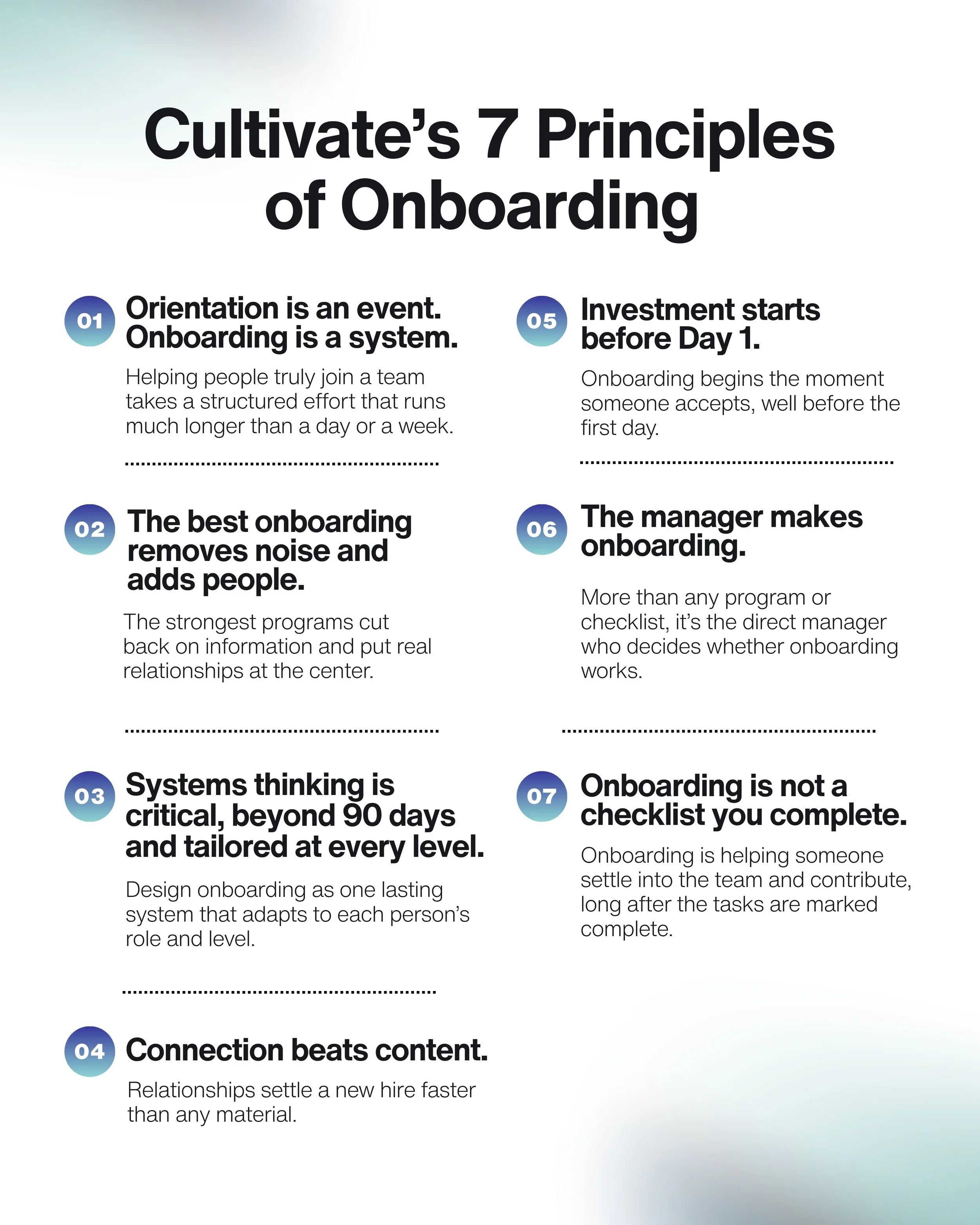
What Your Onboarding Really Says
None of this needs a bigger budget or a longer orientation. It needs seeing the early stretch of onboarding for what it is and always has been – the first activation of your culture. Every piece of it sends the same signal in different forms.
The silence before someone arrives, or the note that says they were expected.
The manager who’s ready, or the one who isn't.
The exposure to the whole company, or the narrowing to a single team.
Each one is your culture answering the question every new person walks in with, the one nobody says out loud.
“What am I allowed to do here?”
The answer gets sent whether you designed it or not. A checklist finished on time still tells people something. So does an orientation that ends and never comes back. A year in, what stays with people is simple. Did the place turn out to be what it said it was on the way in?
So instead of asking if your onboarding runs smoothly, ask what it’s teaching people they’re allowed to do.
Key Takeaways:
Onboarding is the first thing a company's culture says out loud, teaching every new hire what they are allowed to do long before any values deck does.
The experience is set the moment someone accepts the offer, and it runs through the manager more than anyone else, so the weeks before day one matter as much as the ones after.
New hires should be brought into the whole company rather than a single team, because the relationships that reach past one manager are what keep people and speed up their contribution.
Onboarding was never meant to end, and treating it as a program to finish, rather than a practice to keep, is what quietly teaches people to shrink to fit instead of contribute.
Resources:
Gallup, Creating an Exceptional Onboarding Journey for New Employees. https://www.gallup.com/workplace/235121/why-onboarding-experience-key-retention.aspx
Laszlo Bock, Work Rules! (2015). https://www.ere.net/wow-googles-simple-just-in-time-checklist-improves-onboarding-results-by-25/
Rob Cross, How to Succeed Quickly in a New Role, Harvard Business Review (2021). https://hbr.org/2021/11/how-to-succeed-quickly-in-a-new-role
Microsoft, Every New Employee Needs an Onboarding Buddy, Harvard Business Review (2019).https://hbr.org/2019/06/every-new-employee-needs-an-onboarding-buddy
Cable, Gino and Staats, Reinventing Employee Onboarding, MIT Sloan Management Review (2013). https://sloanreview.mit.edu/article/reinventing-employee-onboarding/