BioPharma M&A Runs on Evidence. So Why Does Culture Integration Still Run on Assumption?
"The biggest mistake that people make during acquisitions is (underestimating) the intelligence of the people who built the business that you acquired."
- Nikesh Arora, CEO of Palo Alto Networks
M&As in the biopharma industry are happening at a faster rate than ever before. In the first six months of 2026 alone, the industry spent about $130 billion on acquisitions, nearly matching the full-year total for 2025 in half the time. And when you open the diligence file on any one of those deals, you will find the pipeline valuations and the patent estates stress-tested to the decimal. What you probably won't find is a single page on how the two companies actually work, or what happens to the way they work the moment you fold one into the other.
The money is not only buying the molecules. It is also buying the people who made the science work and the institutional knowledge that never got written down, all of it held together by a culture that the deal model never priced. That is what makes integrating them every bit as decisive as the pipeline itself.
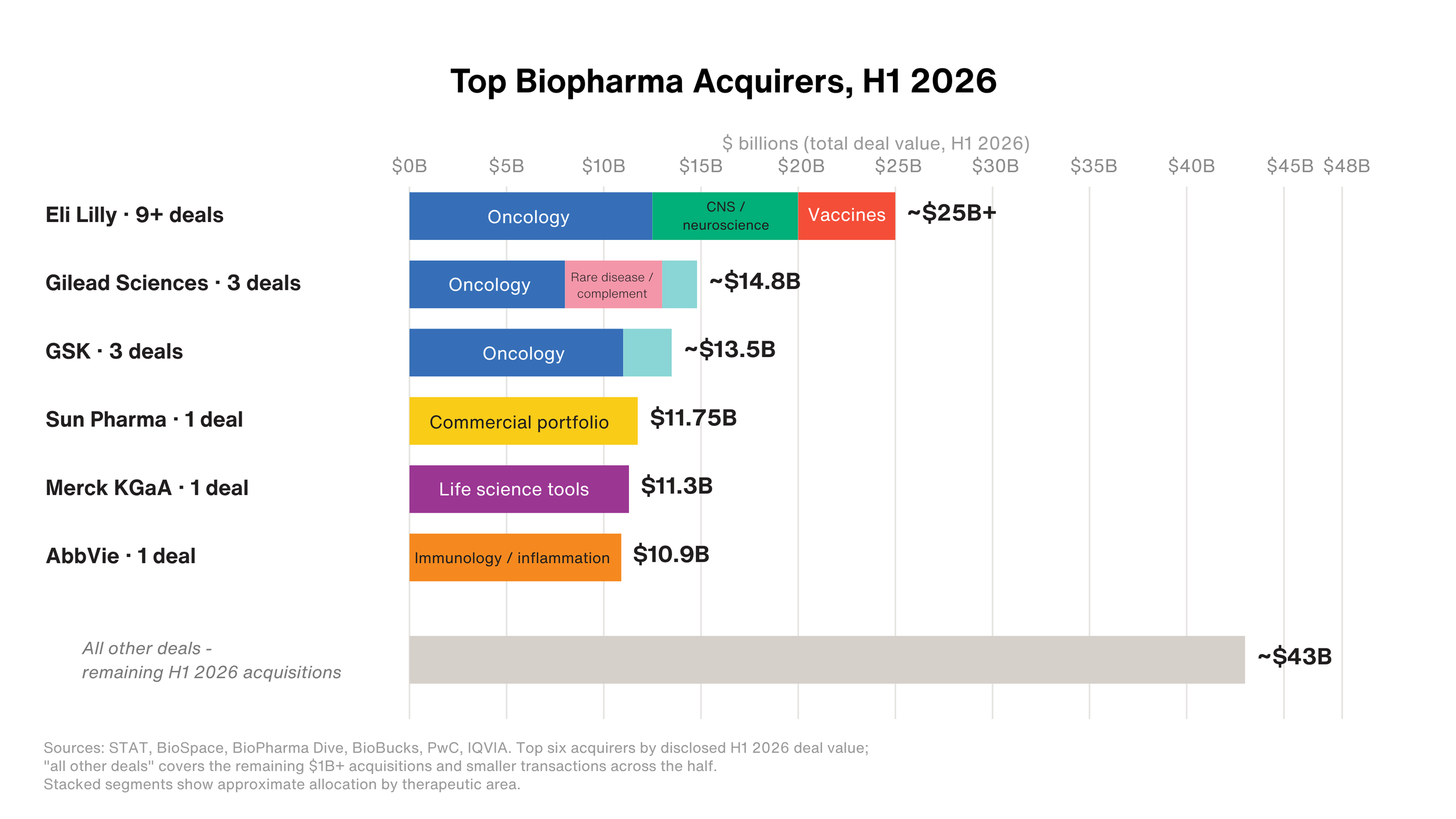
Biopharma might be the most evidence-driven industry there is. Every molecule that reaches approval got there by running the trials and building repeatable systems that follow the protocol to the letter. No major decision in that pipeline runs on instinct. Yet in the most complex organizational event a company can go through, culture integration is almost always treated as the lesser workstream, usually running on an unstructured, feel-based approach. It gets improvised and handled after the close, while the scientific rationale was rigorous from day one.
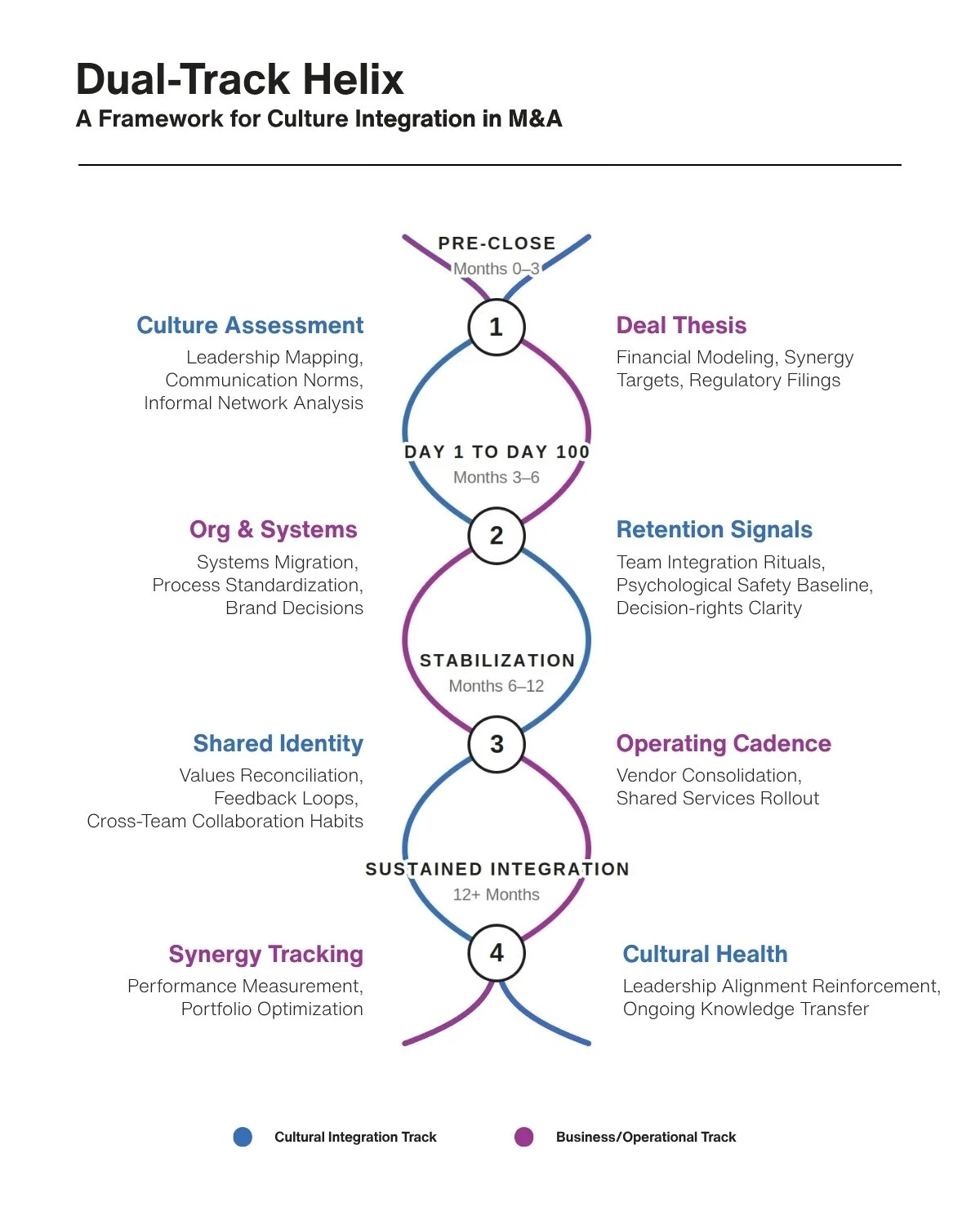
You’ll find that pattern in almost every deal. In a clean integration, the operational side and the cultural side move together in parallel. The failure most acquirers back into is a single-track integration, where the business strand races ahead while the cultural strand stays put.
Culture Integration Starts Before the Deal Closes
The day an acquisition goes public, the work of holding two companies together begins, usually before anyone has been put in charge of it. People on both sides start reading the signals and deciding how much to trust the change. Bring in hundreds or thousands of new colleagues without a shared way of working, and you’ll feel the friction almost immediately. A decision that used to take one conversation starts taking three.
From there, the science itself takes the hit. Research on pharmaceutical acquisitions has found that the scientists disrupted the most are the ones who lost standing in the combined company, the people who were central before the deal and suddenly are not. The work you paid the premium for slows down, and often no one connects it back to the integration. Most companies wait until after the first 100 days to plan the people side in earnest, and by then, the patterns have already set. The ones who get this right treat culture integration with the same pre-close urgency they bring to financial modeling and regulatory filings, and they start months before Day One.
The People Side is Where the Rigor Runs Out
The precision that defines scientific and financial diligence rarely reaches the people side. In most deals, the target's talent gets praised in the announcement and then left to sort itself out after the close, and the people you were counting on most are the first to feel it. Culture gets read on impressions, if it gets read at all. When a biotech gets absorbed, the inventors most likely to walk are often the ones whose work drove the deal in the first place.
The numbers are hard to look away from. A 2025 study in the Journal of Business Research tracked 15,318 inventors across 1,375 biotech acquisitions and found citation-weighted patent productivity fell 35% after a deal, with inventor turnover up 13.5%. The steepest productivity losses fell on the inventors who stayed, especially those whose expertise sat closest to the acquired company's core. It just goes to show that you can complete the acquisition and still lose the thing you were buying.
The Losses No One Can See Right Away
When an integration runs only on one track, the operational one, the first losses are the ones no one can see right away. The most expensive damage is the kind you cannot measure in the moment. When people leave, they take the parts of the company that were never written down. They take the quiet networks that got decisions made, and the trust that let someone run an experiment before they were sure it would work. None of it shows up as missing right away. It surfaces months later, when a deliverable slips and no one can trace why. An MIT Sloan study found that 33% of acquired employees leave within the first year, nearly three times the rate of comparable new hires. The ones who leave are visible. The ones who stayed and checked out are not, and they are often the bigger loss.
Because the loss stays invisible until it gets priced in, the strongest acquirers measure the people side the same way they measure the science, continuously and even before Day One.
This is where the Dual-Track Helix comes in. For every move on the business track, there is a matching move on the cultural track that has to happen at the same time and with the same rigor. Advance one while the other lags and you build instability into the deal from the start.
An unclosed loop is a liability waiting to happen
Some acquirers do run the integration on both tracks, and the results are on the record. When Roche moved to full ownership of Genentech in 2009, it did close to the opposite of what most acquirers do. It kept Genentech's research and early development as an independent unit on the South San Francisco campus and left the senior research leadership in place. It also made a point of not imposing its own way of working. CEO Severin Schwan built the integration around protecting the science-driven culture behind Genentech's best-selling cancer drugs, and his warning was blunt. Streamline everything after an acquisition, and you kill the innovation you just paid for. More than fifteen years later, that research group still runs as its own center, and the science kept producing.
Eli Lilly reached the same principle by a different route when it bought Loxo Oncology in 2019. Instead of folding Loxo into its existing cancer group, Lilly built a new oncology R&D organization around Loxo's people and their discovery model. It called the unit Loxo Oncology at Lilly and put Loxo's own executives in charge. One of them, Jacob Van Naarden, went on to run all of Lilly's oncology research, and by 2025 its business development too. In an industry where buying a company for its team rarely holds up, Lilly kept the team and gave it more room, and the oncology pipeline it built became one of the company's real growth engines.
A One-Track Deal Can Still Be Recovered
Not every integration gets there on the first pass. The good news is that a single-track integration can be recovered, as long as you treat the reset with the same rigor you gave the science. Most recovery efforts fail because they treat the problem as large and abstract when the real damage is small and specific. It usually comes down to decisions that no longer have a clear owner, operating norms that never actually merged, and people's quiet loss of confidence in where the company is heading.
From there, the fixes are concrete:
Make it explicit who owns which decisions.
Rebuild operating norms by team rather than by decree, since norms never merge by announcement alone.
Then give the acquired leaders real authority in the areas where their expertise drove the deal in the first place.
Companies that recover take what the early signals were already showing them and use it to design an integration that carries the science and the culture in one plan.
Prove the Culture the Way You Prove the Science
Biopharma is better than almost any other industry at proving something before acting on it. It has built entire regulatory systems around that discipline, and that discipline has saved countless lives. There is no FDA guidance for a culture integration, and no phase three trial that tells you the merger will hold. The companies doing this well have all worked out the same move. They treat the human system with the same seriousness as the scientific one. They assess it and map it before the close, then decide deliberately what to preserve and what to change. They give the people closest to the work something better than a slide deck and the hope that it all holds together.
Key Takeaways:
Culture Integration starts before the deal closes. The day an acquisition goes public, the work of holding two companies together begins.
The precision that defines scientific and financial diligence rarely reaches the people side.
When an integration runs only on one track, the operational one, the first losses are the ones no one can see right away.
An integration that did not go as planned can still be recovered, but only if you treat the reset with the same rigor as the science.