So Your People Can Use AI, But Can They Still Think Without It?
If our talent is starting to lose one of their most valuable abilities that AI cannot replace, what should organizations do?
In one of the more unconventional responses so far, the University of Chicago Law School is challenging its students to find a balance between the no-electronic-devices-in-class policy that now covers every core first-year course and a campus-wide Claude Enterprise rollout that happened five weeks before.
This is not isolated to the academe. Gartner predicts that through 2026, atrophy of critical-thinking skills from GenAI use will push 50% of global organizations to require AI-free skills assessments.
If there is now data pointing to how AI could impact critical thinking, then it is sensible to argue that there are certain aspects, both of work and learning, that need to stay human-only.
The question now is “what can we do to protect human capital in an era where cheap token capital has dominated the workflow?”
The tool helping our people is now affecting how they think
Companies have long measured AI adoption by counting how many people use the tools. Fast forward to the present, organizations are now asking what the tools are doing to people inside the workflow.
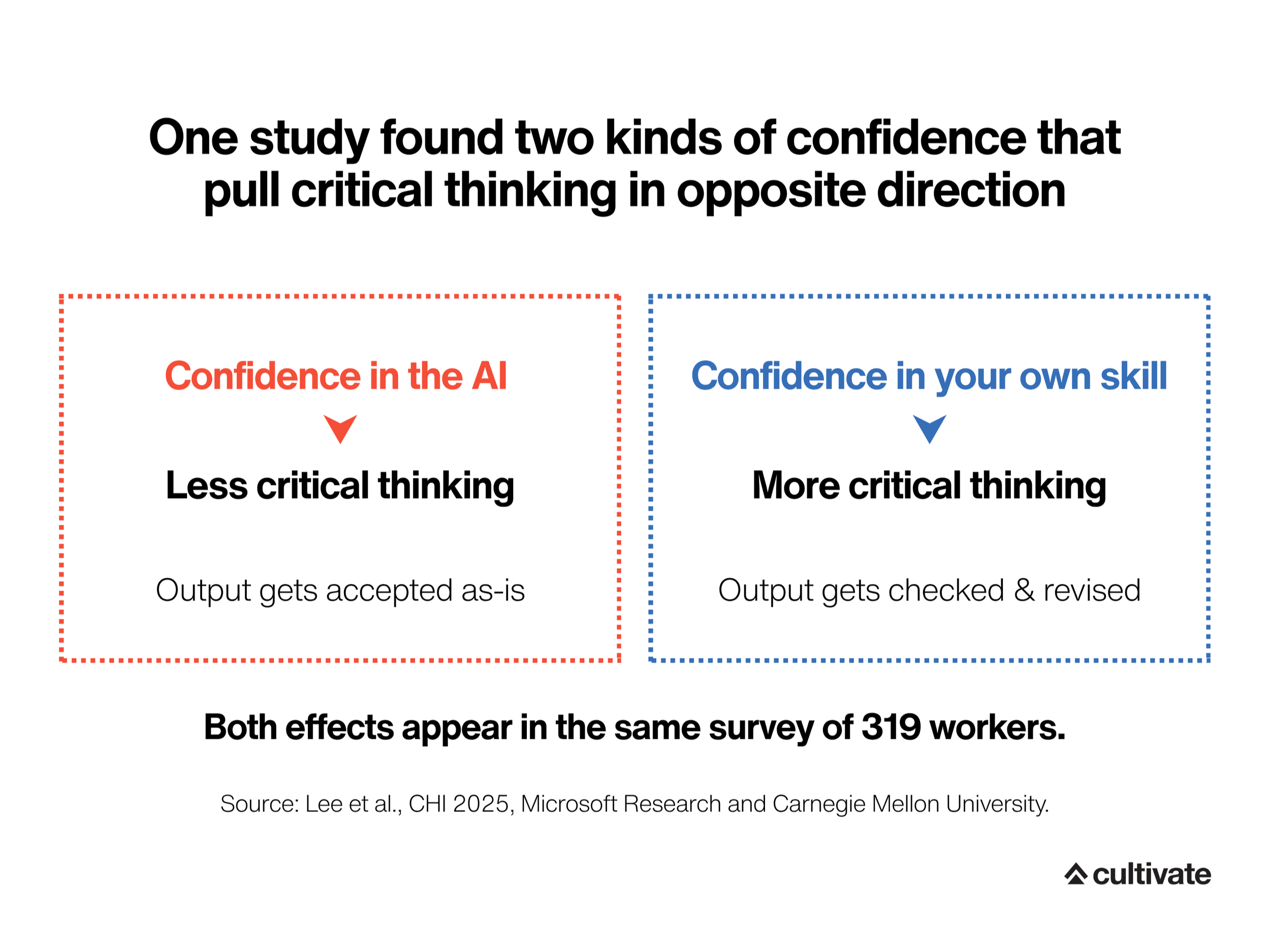
Microsoft Research and Carnegie Mellon put that question to 319 knowledge workers, and gave them 936 examples of real tasks. They learned that when workers were confident AI could handle the task, they reported doing less critical thinking. In the study, they found that workers who were confident in their own skill reported more critical thinking, not less. The reason because they interrogated the output instead of accepting it.
When we lean too heavily on AI, our cognitive muscles can atrophy. A recent study by MIT Media Lab asked 54 people to write essays with ChatGPT, with a search engine, and with nothing. Throughout that whole experience, they ran EEG scans. Results showed that the ChatGPT group showed the weakest neural connectivity, had trouble recalling essays they had written themselves, and reported the lowest sense of ownership over the work. On the other hand, the group that wrote unaided showed the strongest connectivity and could still walk through their own arguments afterward.
While the MIT study is early and other researchers have raised questions about its sample size and reproducibility, the practical issue still holds. If our talent is starting to lose one of their most valuable abilities that AI cannot replace, what should organizations do?
Organizations are now protecting the human skills it cannot replace
The most common corporate response to AI has been about cost. Tobi Lütke, CEO of Shopify, told his teams in April 2025 that they had to show why they could not get something done with AI before asking for more headcount.
The more challenging question to ask is which work needs to stay with a person even when a model can do it faster. Jensen Huang, CEO of Nvidia, has spent most of this year saying that AI automates tasks rather than jobs, and that the purpose of a job is something different from the tasks inside it. Mark Zuckerberg’s August essay argued that superintelligence should be pointed toward invention, and that the outcome depends on whether human capability grows as fast as the automation does. Neither says which should be doing what. Dario Amodei, CEO of Anthropic, got closer, arguing that a serious answer to displacement has to address meaning and agency rather than income alone.
What’s interesting is that these are the very people building the models, and even they are working through the same question leadership teams face. The only difference is that they get to talk about it in the abstract versus org leaders who have to answer it for specific roles and specific work. Thankfully, some organizations have already started addressing the challenge. An example would be Shell and how they redesigned their workflows so that early-career employees must independently frame a problem, test assumptions and produce a baseline analysis before they are allowed to use AI to refine it. They did not remove the tool but they made sure their people would think first before using it. Another example would be CNIL, France’s national data protection authority, where managers now evaluate employees on their ability to challenge AI outputs rather than on how well they use them.
With everything said and done, changing how AI gets used only goes so far if leadership is not modeling it. A Microsoft report shows that when managers modeled thoughtful AI use, employees reported a 22-point increase in critical thinking about their own AI use. That is important because managers who were visible about how they used AI ended up changing how their teams used it, which no policy rollout does on its own.
What AI can and should do are two different things
When people ask “can AI do this?” and then get a quick yes, the work almost immediately moves off their plate. That’s usually where thinking stops. Which is a shame, because some of the work AI can handle is the same work that teaches your people the judgment you will need from them down the line.
IBM took that position in early 2026 when they announced that they would triple its US entry-level hiring while most of the industry cut junior roles. They rewrote entry-level job descriptions to move new hires away from tasks AI can automate (like basic coding) and toward work that requires human judgment (like client engagement and oversight of AI systems). The reasoning comes down to the pipeline. Cutting entry level roles now just to save money risks a longer-term scarcity down the line. The juniors you skip today are the experienced mid-level people you won’t have in a few years, mainly because they never got learn the work the hard way.
Think about something as ordinary as a first draft. AI can write one that looks polished and good enough to send. But if a junior analyst never writes their own version first, they never develop the instinct to notice when something in the numbers does not add up.
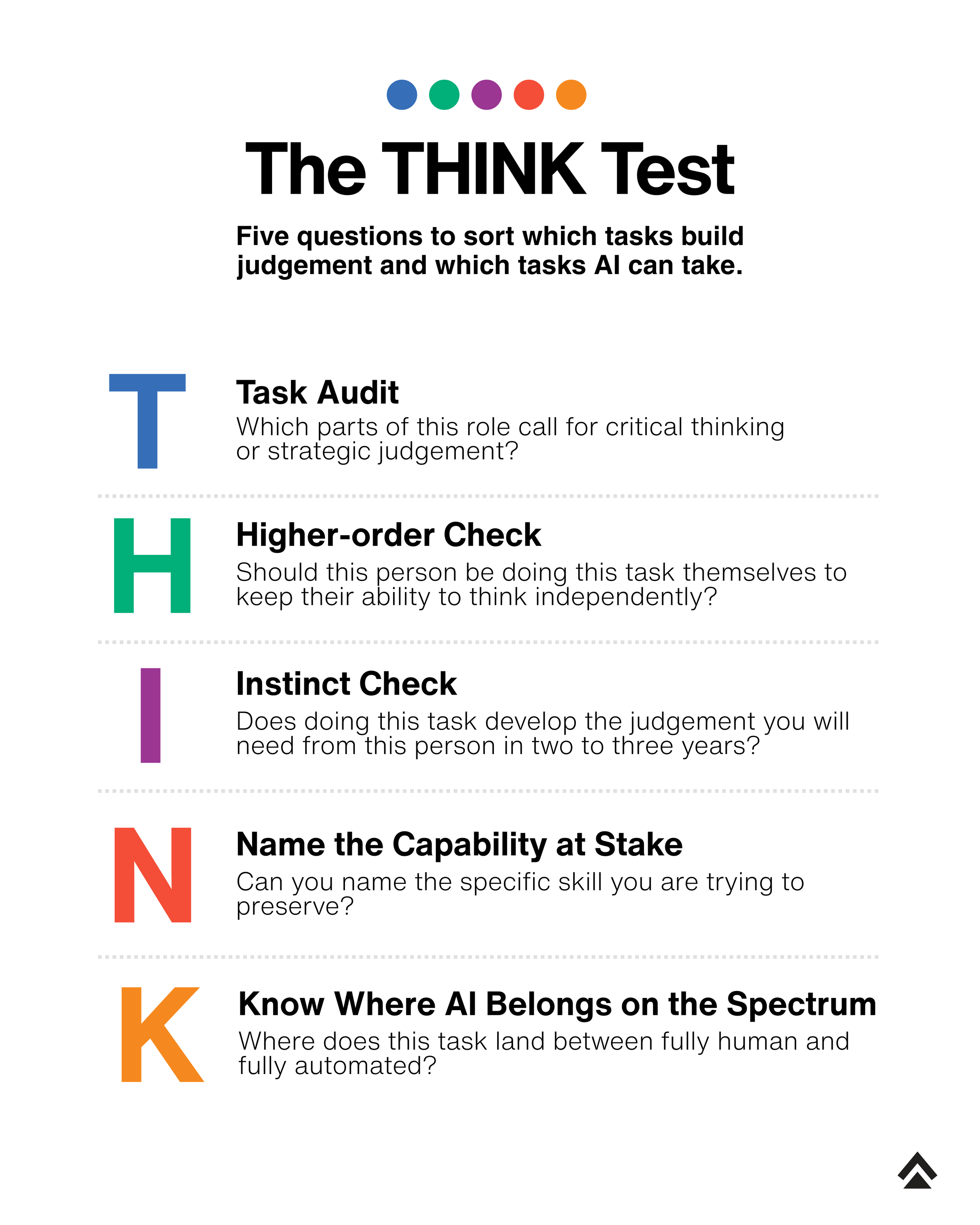
At Cultivate, we believe that developing human judgment means knowing which work builds it and which work does not. It starts at the task level, not with a blanket policy applied across a whole team or function. One way to do that is to use our THINK Test to sort which tasks could be handed off to AI.
T. Task audit. Look at your team member’s job description and specific role. Which parts of their work call for critical thinking or strategic judgment? Those are the tasks where AI dependency will cost your organization the most over time, and they are the ones that are easy to miss at first glance.
H. Higher-order check. Is this a task the person should be doing themselves to keep their ability to think independently? If yes, the follow-up question is what AI can do to assist versus what it should do instead of them. A junior analyst who uses AI to generate a first draft and one who uses AI to pressure-test an analysis they already built are doing two different things with the same tool.
I. Instinct check. Does doing this task develop the judgment you will need from this person two or three years from now? Some work is where people build skills that take years to form. If someone never writes their own problem framing, they will not learn to notice when a model’s output misses something that experience would have caught.
N. Name the capability at stake. Be specific. “Critical thinking” is too broad to work as a guardrail, so name the actual skill: the ability to frame a problem before seeing data, or the instinct to push back on an output that looks clean but does not match what the person knows about the context. If you cannot point to a specific capability you are trying to preserve, you will not know when it starts to erode.
K. Know where AI belongs on the spectrum. Once you know what you are protecting, place the task on the AI Delegation Spectrum. Most of the work worth debating falls between fully human and fully automated. Where a task lands should depend on the person’s seniority and on whether the capability it builds is something your team has enough of.
The work you defend now is the judgment you will have later
Pick five or ten things your team did last week and run both questions against each one. Can AI do this, and does doing it teach the person something you will need later? Most will sort without much debate. A few will answer yes to both, and those force a choice between your human and token capital. You have to defend keeping a person on work that AI could finish in half the time.
The thing about token capital is that it has a shelf life. Zuckerberg described AI as an industry where innovations get copied and absorbed within months, where even a two-month lead could change a lot. Whatever your company spends on token capital now, your competitors will have something comparable not long after. It may already be happening without you knowing.
Your people build judgment by doing work they could hand off to an AI tool, and by handing it off, their judgment stops developing without anyone noticing. If every AI tool your team uses went dark for a week, which of your people could still do their job well? And which ones would struggle with work they used to own?
Key Takeaways:
People are losing the ability to think independently without AI, and companies are only now catching it.
The organizations acting on this are building guardrails around the human skills AI cannot replace.
To protect human judgment, identify which work teaches your people and which work AI can handle.