A Business Leader’s Guide to World Models: The AI Building the Future of Work

"World model" is becoming one of the most talked-about terms in technology circles.
In the first quarter of 2026 alone, two companies raised over $2 billion combined to build this technology: Fei-Fei Li's World Labs raised $1 billion, and Yann LeCun's AMI Labs raised $1.03 billion in Europe's largest seed round on record.
With a growing share of capital being directed at AI that understands physical reality, it’s worth understanding what’s being built.
Large Language Models (LLMs) changed how teams draft, research, and communicate. Those tools learned the structure of text. World models, on the other hand, are learning the structure of the physical world—how objects move, how systems respond to force, how a room looks from an angle nobody has photographed.
If how organizations interact with AI went from a chat window to a simulation of the environment your business operates in, what would that change?
Spatial Intelligence: A Working Definition
The person with the clearest answer to that question may be Fei-Fei Li, a Stanford professor and the CEO of World Labs.
When she co-created ImageNet in 2007, the database that helped launch modern computer vision, the goal was to give AI systems their first reliable way to recognize objects.
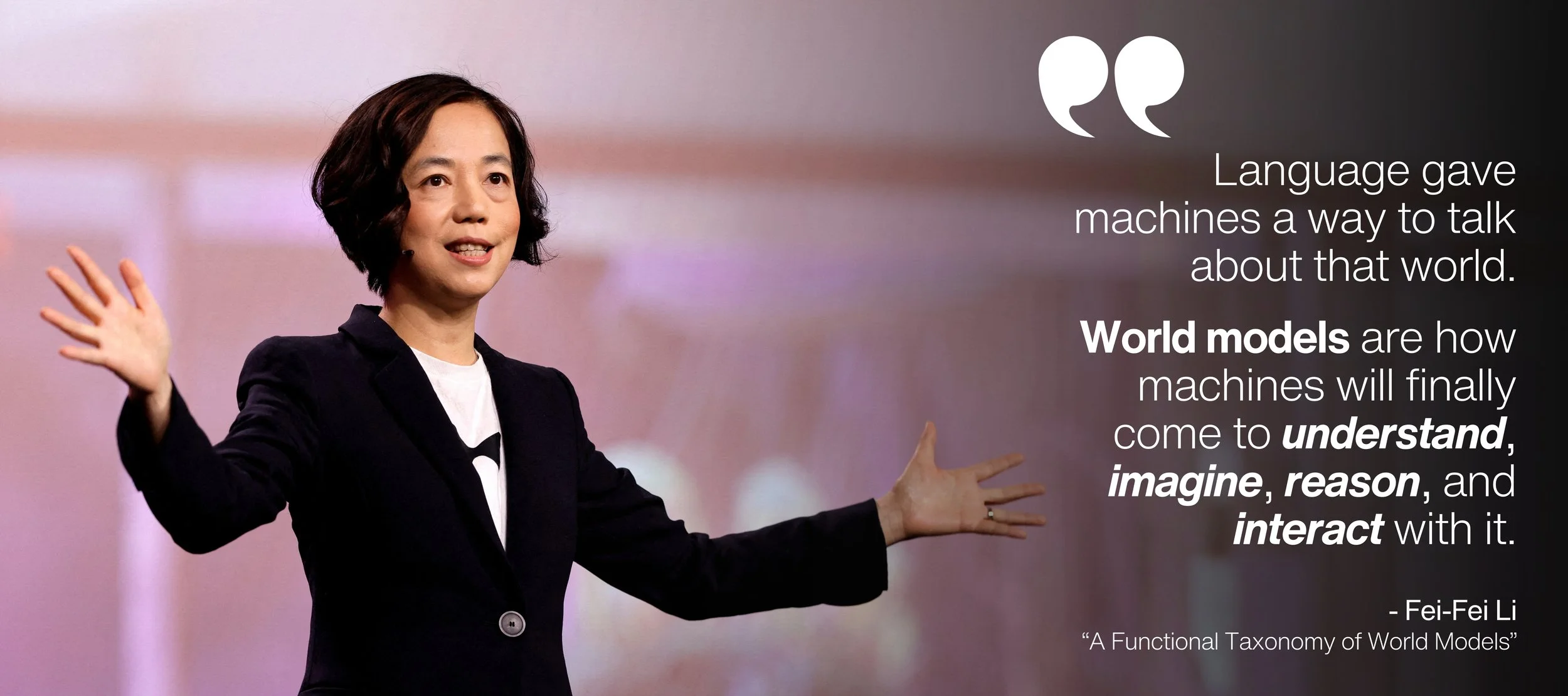
In her essay published June of 2026, "A Functional Taxonomy of World Models," she described what her company is creating as "spatial intelligence," AI that can perceive, generate, reason about, and interact with three-dimensional space.
Think of a self-driving car.
It sees the road through cameras, builds a model of the scene from partial information, predicts what happens next, and decides what to do.
That loop, played out millions of times across different scenarios, is how a world model learns.
In 1943, British psychologist Kenneth Craik proposed that human cognition works the same way, the brain builds small-scale internal models of the world and runs simulations before acting. Li's work is an attempt to give machines that same capacity.
Li’s framework categorizes world models into three functional types based on what they produce:
renderers (output what things look like),
simulators (model how systems work underneath), and
planners (decide what to do next)
And among those three, Li argues that simulation is the hardest and most valuable because it bridges seeing and acting.
What Do Research and Investment Signals Tell Us?
Based on the current investment pattern, the capital is leading World Models towards infrastructure-level, not just research-grant-level, funding.
World Labs raised $1 billion in February 2026, with investors including Autodesk, AMD, Nvidia, and Fidelity, while Yann LeCun left Meta to launch AMI Labs and raised $1.03 billion at a $3.5 billion valuation. Wayve, a UK self-driving company, raised $1.2 billion, while Physical Intelligence secured $600 million for robot foundation models.
On top of funding, there's now data showing that applying World Models could be a game-changer across industries. In July 2026, a robotics and simulation company called SceniX joined Li's World Labs. SceniX built what it calls a real-to-sim-to-real (R2S2R) engine. It takes one real robot task, rebuilds it as a faithful interactive simulation, then changes the lighting, the clutter, the physics, and the camera angle to produce thousands of versions of that one task.
This adds another layer to what Li has been saying. Robots don’t get better by being smarter models, but by doing a task many times. And in the real world, each attempt is slow and costly since someone has to reset the objects, recover from the failures, and keep the hardware running.
A robot that runs out of attempts remains as a lab demo. World Labs says their robots now learn a task entirely in simulation and carry that over to real hardware, and that a test in simulation can show where a robot will fail before it runs for real. That's what World Labs is seeing so far, backed up by the company's own early results.
The startup pipeline is now also pointing at very specific industrial uses.
At YCombinator, One Robot is building simulation environments for manufacturing assembly and material handling, while Congruent is working on radar simulation for autonomous vehicles. The a16z 2026 thesis includes autonomous labs where AI and robotics converge to run scientific experiments, and an industrial "data crusade" where companies in energy, manufacturing, and logistics capture operational data to train proprietary AI models.
A survey by arXiv shows that world models are "time-compressed approximations" of physical processes, enabling researchers to predict outcomes of molecular simulations and materials science experiments without running the full experiment.
What This Connects to in Science-Led Organizations
For science-led organizations, especially in the Life Sciences, Energy, Manufacturing, Industrials, and Information Technology industries, the development of world models could potentially impact drug discovery, manufacturing simulation, clinical trial design, energy infrastructure, and supply chain operations.
These are roles where decisions play out in three dimensions and carry consequences that no language model can approximate.
Novartis reported using AI-driven simulations to identify gene candidates for kidney disease research, a process that would have taken far longer without computational modeling. That shift toward computer-based methods is also regulatory: the FDA announced that it would begin phasing out mandatory animal testing for many drug types. Outside pharma, Waymo adopted Google DeepMind's Genie 3 to generate driving scenarios that real cars rarely encounter.
A Thought Experiment for Business Leaders
The building blocks for this next wave of technology are moving fast.
When the physical environment can be simulated, the way people train and make decisions in that environment changes with it. Think about how this could affect your organization in the next two to three years.
If a drug candidate could be stress-tested against a simulated biological environment before a single trial, who decides when the simulation is trustworthy enough to act on?
If the lab, the factory floor, and the clinical site could be modeled and rehearsed before anyone walks in, which parts of how you hire, train, and develop people still make sense? Which parts do you need to start implementing differently?
Key Takeaways:
“World models” is an emerging trend that discusses how AI can predict reality instead of text. They are the next phase after LLMs, and the investment behind them is already at infrastructure scale.
Fit is the diagnostic question to lead with, not maturity. Localized and integrated postures are different choices, not different stages.
The Canvas opens conversations, not scorecards. The hour leaders spend on the conversation it triggers is what moves the function forward.