
Photo by Enrico Da Prato (@enricodaprato) on Unsplash
On loss of exclusivity and patent cliff, and what this means for leadership development
Most disruptions arrive without warning. A competitor makes a surprise launch, some regulations shift, and the news unexpectedly moves the market. Leaders end up reacting on the fly, because nobody saw it coming.
Loss of exclusivity is different. A biopharma company knows, often a decade in advance, the year its most important product will lose patent protection and generic drugs will reach patients. The date sits in public filings, analyst models and board presentations. It is about as close to a certainty as business gets.
Companies treat that date with great seriousness on one side of the house. Finance models the revenue decline quarter by quarter. Business development hunts for assets to fill the gap. Lifecycle teams work on new formulations and indications to soften the drop.
Leadership development, in most companies, runs on a different clock. Programs follow the annual talent cycle, the competency model refreshed three years ago, and whatever the last engagement survey flagged. The patent date, the one event that will most reshape what leaders need to do, rarely appears in the plan at all.
The date everyone else is planning around
The industry is entering one of its largest waves of patent expirations. Morgan Stanley analysts estimate that products losing exclusivity through 2030 generate about $183 billion in annual sales. GlobalData projects that by 2030 only 4% of global drug sales will still be patent-protected, down from 12% in 2022.
The most visible case is Merck's Keytruda, the world's best-selling medicine. It brought in about $31.7 billion in 2025, more than half of Merck's pharmaceutical sales, and its intravenous form loses US exclusivity in 2028. Bristol Myers Squibb faces Eliquis and Opdivo expirations in the same window, and Johnson & Johnson's Darzalex follows close behind.
None of this is a surprise, and the financial response shows it. Merck launched a subcutaneous version, Keytruda Qlex, in 2025 to carry patients past the IV patent. Companies across the industry are pursuing acquisitions, label expansions and next-generation therapies. Every one of those moves is planned backward from a known date.
The company that comes out of a patent cliff is not simply a smaller version of the one that went in. Before the cliff, leaders manage a product the market already wants.
After it, growth has to come from a steady run of new launches, mostly in specialty markets. In 2025, nearly three-quarters of new FDA approvals were specialty drugs, and many are entering classes that are already crowded. In these markets, insurers, specialty pharmacies and health systems shape every sale, and FDA approval no longer guarantees coverage.
That is hard to do well. IQVIA's launch research finds that the more launches a company runs, the fewer of them excel, and that large, general-purpose sales forces no longer give companies an edge in specialty markets. The old blockbuster playbook holds the next launch back, and it lives in leaders' habits as much as in process documents.

Photo by Mikhail Nilov on Pexels
The shift shows up in concrete leadership work. Leaders have to run launches as a repeated discipline, building teams that can stand up, learn fast and hand off several times a year rather than once a decade. They need fluency in payer economics, pharmacy channels and health-system decisions, not just physician demand. With no single product carrying the company, they must make hard calls about which assets get people, money and attention. They have to compete rather than defend, trading the caution that protects a dominant product for the speed and appetite for risk it takes to win share from an established rival. And many will do all of these while restructuring the legacy business and asking people to invest in the new one.
A workshop can introduce these capabilities, but it cannot build them on its own. Leaders develop them by doing the work, such as running a launch, sitting across from a payer, or making a portfolio call and living with the result, with coaching and reflection built around each experience. That is where leadership development earns its place: deciding who gets which experiences, in what order and with what support. Each of those cycles can take a year or more.
This is the core timing problem. If a capability takes three to five years to build at scale, and the revenue decline is what triggers the investment, the company will be learning on the job at the exact moment it can least afford mistakes. By the time the first quarter of erosion shows up in the results, the leaders who will steer the next decade should already have done this work.
Plan backward from the patent date
The "hidden in plain sight" solution isn't all about coming up with new programs or strategies. Instead, consider a different starting point. Treat the patent date as a development deadline and plan backward from it, just as the rest of the business already does.
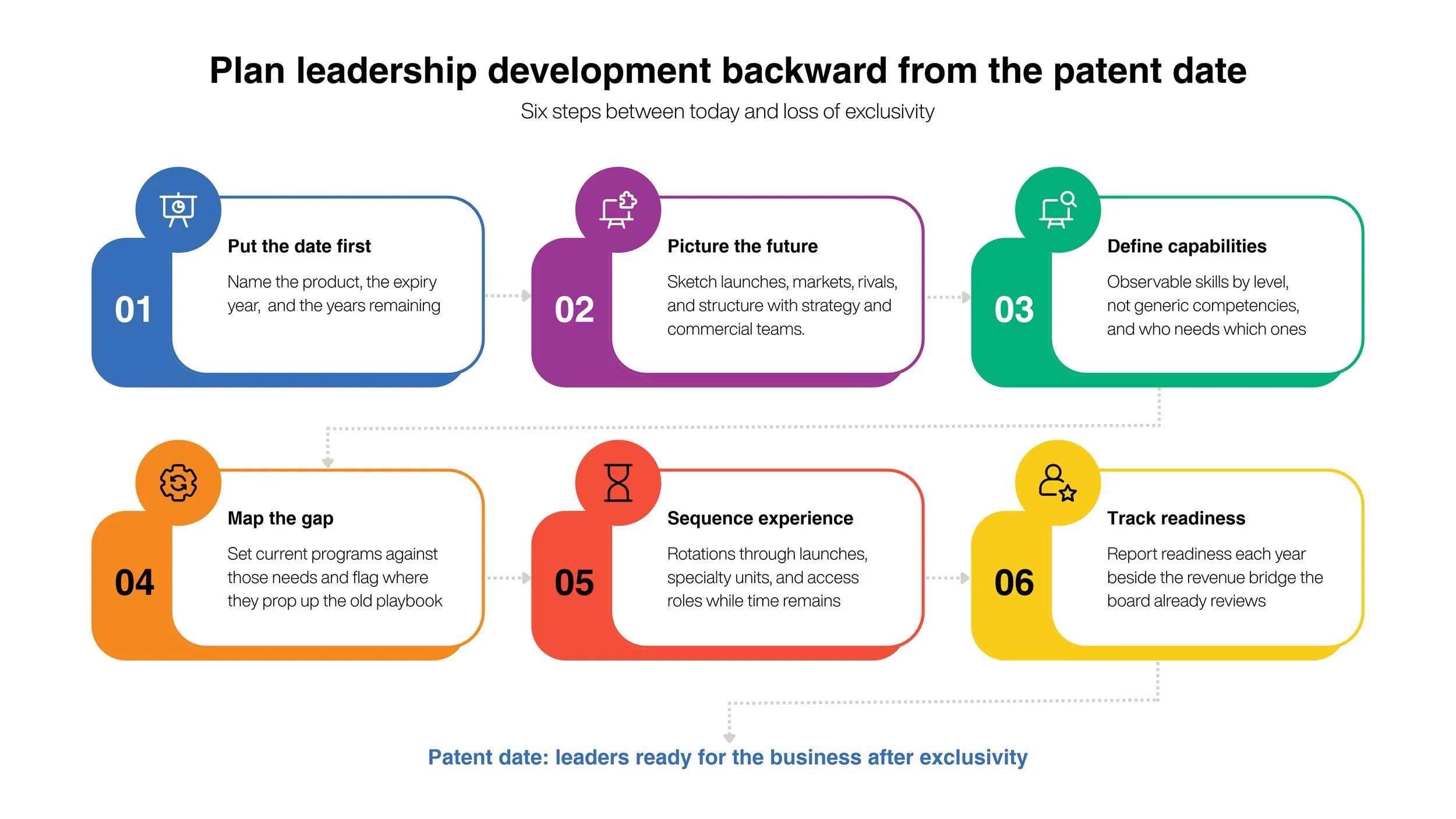
Fig. 1: Six steps for planning leadership development backward from the patent date
The deeper shift is in how L&D positions its work. A capability plan tied to the patent date becomes part of the company's response to its most predictable risk, and it can be discussed in the same rooms and with the same rigor as the pipeline.
The one certainty worth planning around
It’s a given that biopharma lives with uncertainty. The patent date is one of the few fixed points in that landscape, and companies are already building their financial strategy around it.
Leadership development deserves the same treatment. The leaders who will run the business after loss of exclusivity are already in the building. Whether they arrive at that date ready depends on decisions L&D makes in the next year or two, not the year the revenue starts to fall.
The clock is already running. The only question is whether development is running on it.
Key Takeaways:
Patent expiration is a predictable disruption, yet only the financial side plans for it.
The business after the patent cliff needs different leadership skills.
L&D should treat the patent date as a leadership development deadline.