AI Gave Product Teams Their Time Back. Customers Never Saw It.
Photo by Morgan Housel on Unsplash
If our talent is starting to lose one of their most valuable abilities that AI cannot replace, what should organizations do?
Before AI tools became mainstream, Pragmatic Institute recommended that product managers spend about eight hours a week with customers. However, in its 2019 survey of nearly 2,500 product professionals, nearly three-quarters reported spending less than five hours a month.
AI was supposed to close that gap, and adoption is no longer the issue. Early findings from our client work show about 95% of product managers use AI every day. Yet the gap hasn't moved. In Product Focus's 2026 survey of 677 product professionals, 71% said they still don't spend enough time with customers and the market. The time came back. It went somewhere else.
Where the hours went
The saved hours are flowing back into internal work. Pragmatic Institute's 2025 report found that AI is cutting rote work, but the reclaimed time is "absorbed by coordination and alignment rather than market learning or decision clarity."
Other data points the same way. Atlassian's State of Product 2026 found AI saving product teams 10 to 60 minutes a day, yet 49% still lack time for strategic planning, roadmap work or deep analysis. Product Focus found that 60% of product managers are frequently pulled into unplanned work, and only 25% spend most of their time on strategy. In 2019, that figure was 27%.
Six years and one technology shift later, the shape of the job is almost unchanged.
Think about your own team. If AI handed them few extra hours this week, where would those hours actually go?
The case for internal work
It's tempting to call this a discipline problem. In most cases, it isn't. Product managers know customer time matters, and they have good reasons to spend saved hours inside the company instead.
Internal work is where the job gets done. Product managers lead without authority, so an insight changes nothing until engineering, sales and leadership buy in. AI adds to that load. Glean found it speeds up documents like product requirements, briefs and updates, but the judgment calls behind them don’t get any faster. This leaves more to review and align on. And because customer signal already arrives secondhand through tickets, sales notes and usage data, one more internal session can feel like the better use of an hour.
Internal work is also what gets rewarded. Product managers are measured on shipping, and decisions, credit and visibility all happen in the room. Customer contact pays off later and less certainly. Even product managers who want more customer time face friction. Rich Mironov, author of The Art of Product Management, points to two common barriers. Some product managers doubt their interviewing skills, and sales teams often guard their accounts, believing they already know what customers want.
Each of these choices makes sense on its own, and together they keep product managers busy inside the company.
Why it still costs you
The cost of all this shows up late. Research on product development has long found that a product's fate is largely decided early, in the customer and market homework done before engineering begins. Late customer input rarely rescues a weak product definition.
A skipped meeting causes trouble this week. A skipped customer conversation causes trouble next year.
The customer time that does happen is often firefighting. Much of it goes to failing accounts, while satisfied customers are handled by the channel. The resulting picture is built mostly from complaints — detailed, but biased.
The gap is also widest at the top. Product Focus found 75% of heads and directors say they lack enough customer time, compared with 59% of junior product managers. The people setting direction are the furthest from the customers.
Stop counting who uses AI
If product managers are making sensible choices in a system that rewards internal work, asking them to care more about customers won’t fix it. Neither will more AI, if companies measure AI by who uses it through logins, licenses and weekly active users. Companies that look beyond usage tend to count features shipped, hours saved and documents produced. AI can push all of those numbers up without helping a single customer.
Product Focus found that 97% of product managers report better personal productivity from AI, but only 64% report better product outcomes. High usage doesn’t guarantee better products. Most companies ask, “Are people using AI?” The more useful question is, “What got better because they did?”
Two studies show why. In a 2025 NBER field experiment across 66 firms, about 80% of workers offered Microsoft 365 Copilot used it and saved around two hours a week on email. By a usage count, that’s a success. But the amount and kind of work they did didn’t change.
A 2023 NBER study by Erik Brynjolfsson and colleagues found something very different. There, AI suggestions were built into the live work of 5,179 customer-support agents. Issues resolved per hour rose 14% on average, and 34% for newer, less-skilled agents.
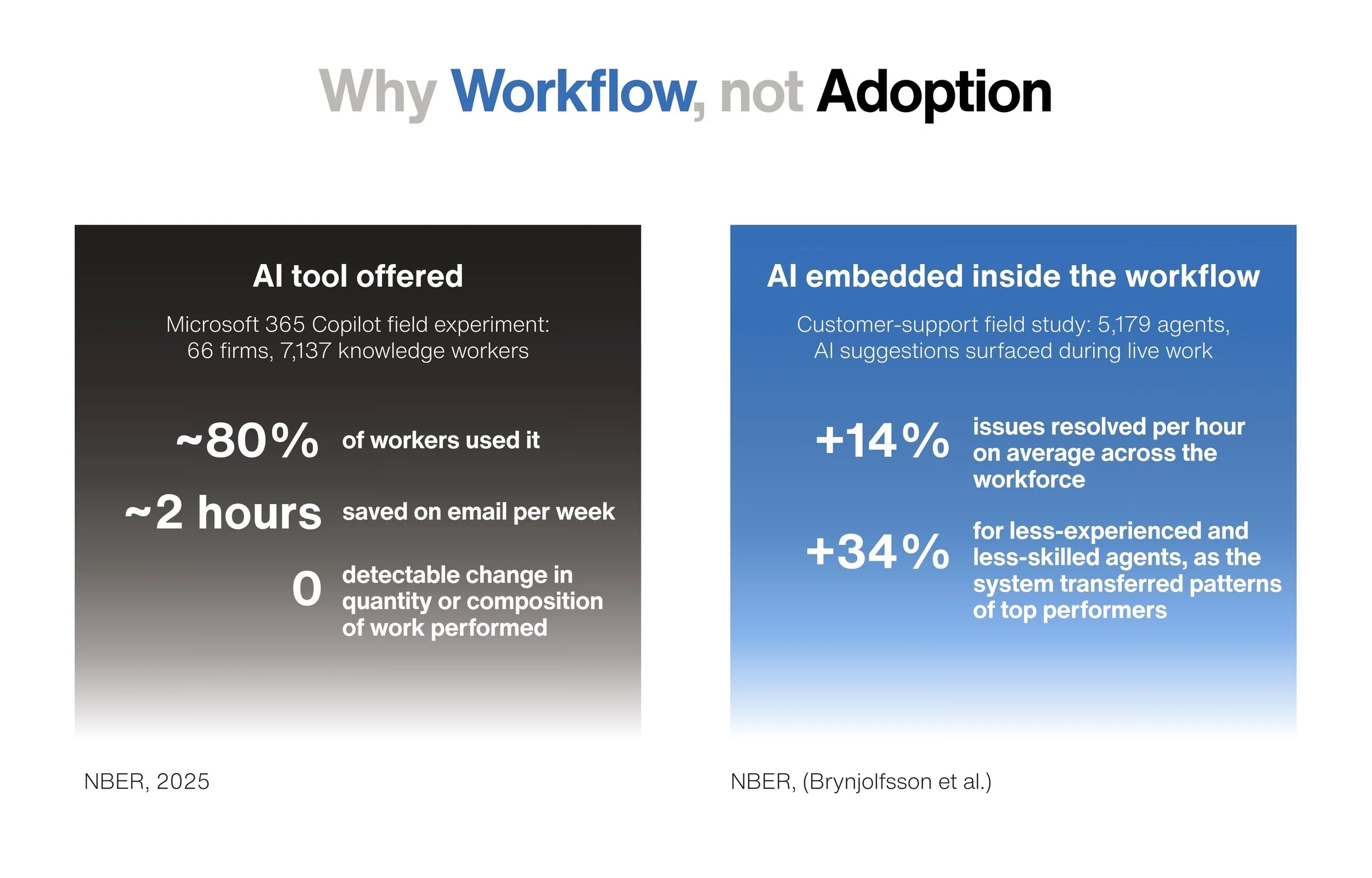
On one study, AI gave people new tools for old work. The other gave them new ways of working. Adoption saved minutes, while redesign changed results. That second step is the one most product teams skip. On the ladder below, most companies measure only the first two rungs. The value shows up at the fourth and fifth.
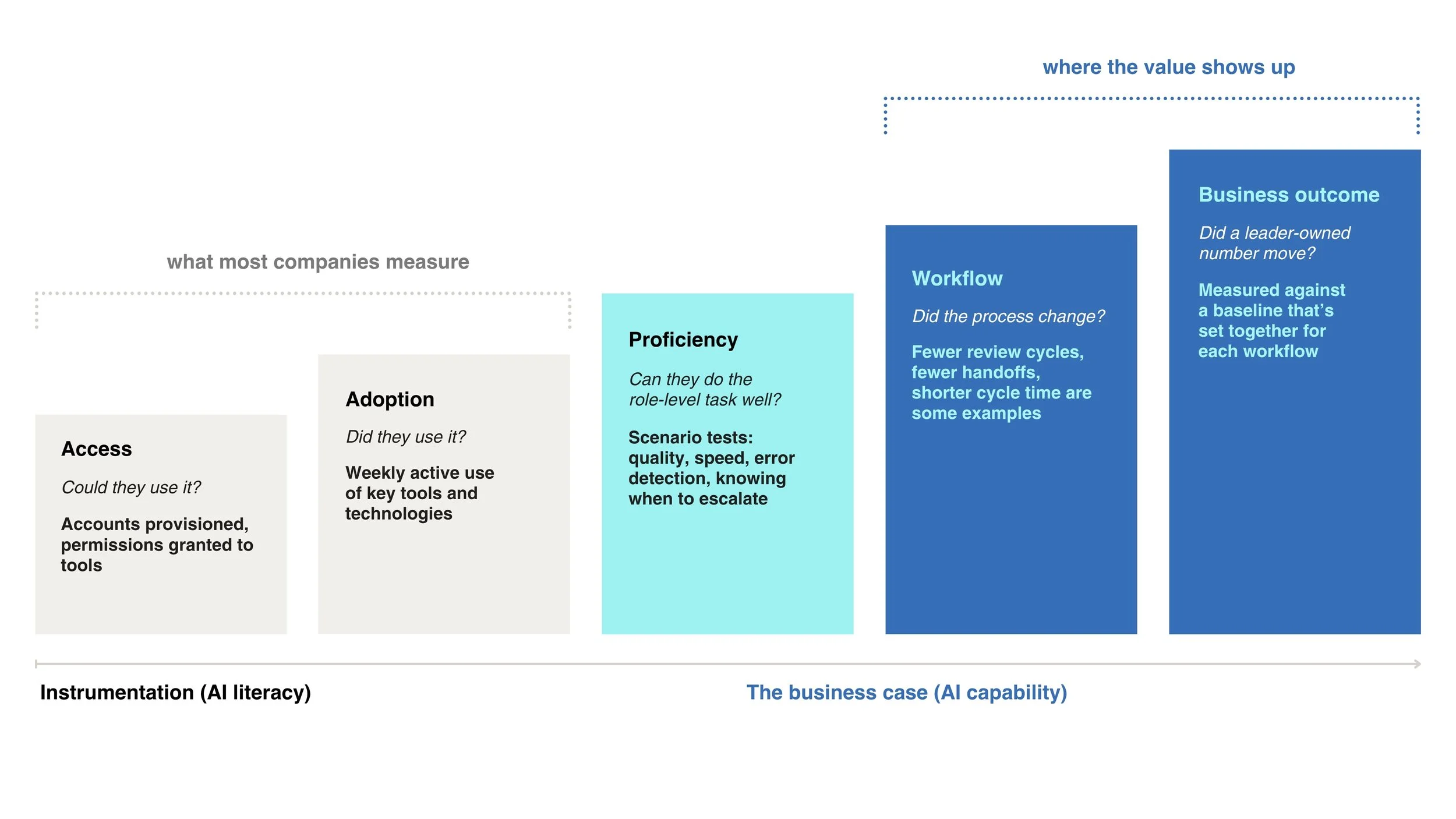
Fig. 1: The AI measurement ladder. Most companies stop at access and adoption. The value shows up higher, when workflows change and a leader-owned number moves.
Redesign one workflow
Leaders often associate the word “redesign” with “who reports to whom?” That changes the org chart but keeps the work the same. The harder question is what work still needs people at all.
So start by looking at your team’s internal time. How much of it is real alignment, and how much is status work AI could absorb?
Next, choose one customer-facing workflow, such as discovery before a roadmap decision, and measure where it stands today. Track the hours spent with customers, how many of those conversations feed the decision, and one downstream metric you already own. Then redesign the workflow so AI absorbs the internal work around it, like prep, synthesis and the status updates that would otherwise become meetings. Protect the freed hours for customers and match the cadence to the decision rather than a rigid weekly quota. If that metric, such as win rate or time to market, improves the baseline, you have your proof.
Put simply: pick one job, measure it, let AI take the busywork, protect the time it frees up for customers, and check whether results improve.
The time is already there
AI already found the time. Your product managers are spending it the way the system tells them to. Whether any of it reaches a customer comes down to how the work is designed, and that decision belongs to the product leader.
So stop asking how many hours AI saved. What did your team buy with them?
Key Takeaways:
The hours AI saves product managers are going back into internal work, not to customers.
This isn’t a discipline problem because product managers are working hard, just on things that keep them away from customers.
Measure what AI changes, not who uses it, and redesign workflows to protect customer time.