Fast Model or Smart Model? The Ten-Second Decision Behind Your AI Token Bill
There are two ways to bring a problem to AI. Either you know the question and want the answer, or you have a direction you cannot yet put into words.
Felix Rieseberg, the engineer who led the development of Claude Cowork, picks his model by which of the two he is in: a faster model when the problem is well defined, a stronger one when he needs the tool to work out what he means rather than match the words he typed. The practice of matching each request to the model built for it, instead of defaulting to whichever one costs the most, has a name now: model routing.
And this week the choice stopped being theoretical.
The largest open AI model ever published arrived from a Beijing lab, and within hours developers in blind testing preferred it to every leading American system for front-end coding, the work of building web interfaces. Moonshot AI's Kimi K3 carries 2.8 trillion parameters and a million-token context window, and it is open-weight, which means anyone will be able to download, inspect and run it once the files are released on July 27, much the way open-source software works. In blind tests run by the evaluator Arena, developers ranked it above Anthropic's Fable 5 and OpenAI's GPT-5.6 Sol for front-end coding, and on Arena's broader leaderboard it outranked models that sat at the frontier of AI a few weeks ago. Reuters called the launch the clearest sign yet of how fast China's open ecosystem is closing on the most advanced US systems.
Here's the catch, especially for anyone who owns an AI budget. Kimi K3 is not the cheap option. It is priced like a mid-tier Western model, around $15 per million output tokens, and the fund manager Gavin Baker notes that on Artificial Analysis' cost-per-task data it costs more to run than OpenAI's most token-efficient flagship tier. Baker still called the release a potential inflection point, one he framed as "potentially negative for Anthropic and OpenAI while being net positive for essentially every other company in the world." Premium pricing holds only while there is no credible alternative, and the alternatives just became credible.
The instinct to route around expensive AI is turning up in places you would not expect.
Apple confirmed this spring that Mac mini and Mac Studio shortages could run for months after developers bought up high-memory machines to run AI agents locally rather than pay for cloud subscriptions. And Mira Murati's Thinking Machines answered Beijing this week with Inkling, an open model of its own, a bet that the West needs a credible entry in a category Meta has been stepping back from since Llama 4 underperformed.
As CFOs start measuring the ROI on token spend, routing well stops being an engineering detail and becomes more of a people question. Your teams make that call every day, and for it to go right, your people have to tell the difference between needing an answer and needing to think.
So consider if and how your team selects a model depending on the task in front of them.
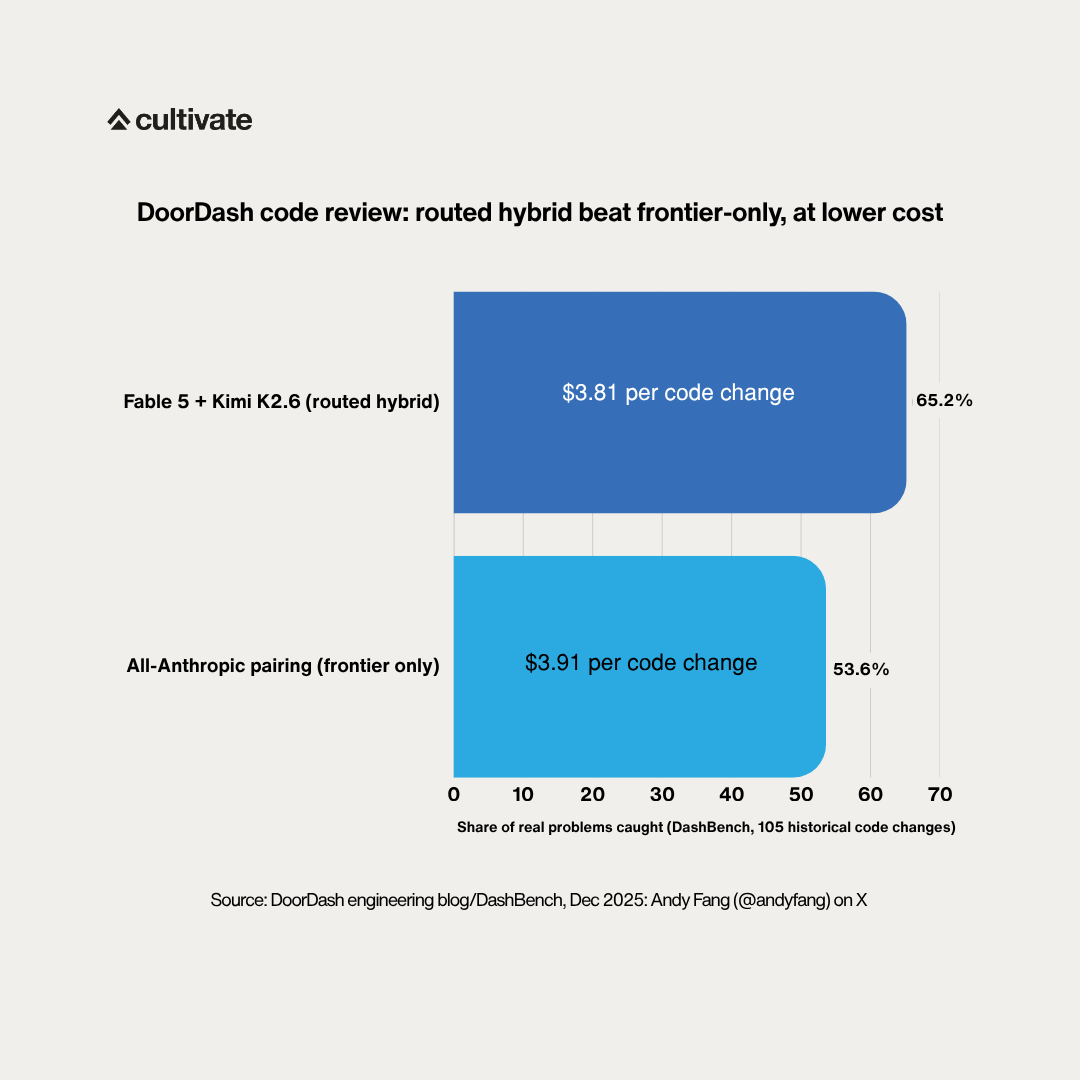
Companies are building the same instinct into how they operate. DoorDash had no way to count the bugs its AI code reviewer was missing, so it built DashBench, an internal test that replays 105 of the company’s past code changes and scores how many real problems each setup catches.
And surprisingly, the winner was not the all-premium configuration. Sending the hardest reviews to Anthropic’s frontier model and the routine ones to Kimi K2.6, a much cheaper open model, caught 65.2 percent of real problems against 53.6 percent for the premium-only pairing, and it cost slightly less per change. “Better quality, cheaper cost” is how CTO Andy Fang summed it up. Perplexity CEO Aravind Srinivas takes the point further, arguing the durable value in AI will sit in the layer that decides which model gets which task, what he calls “orchestration and model routing,” not in any single model.
If DoorDash needed a purpose-built test to make this call well, what are your people using every time they open the prompt box?
The model you pick is a cost decision most teams make on autopilot
Most of your people are not writing code or touching an API. They open the Claude, ChatGPT, or Gemini app and type. Every message they send and every reply they get back is broken into tokens, small chunks of text a few characters each, and the company running the model charges for both directions. A longer question costs more and so does a longer answer.
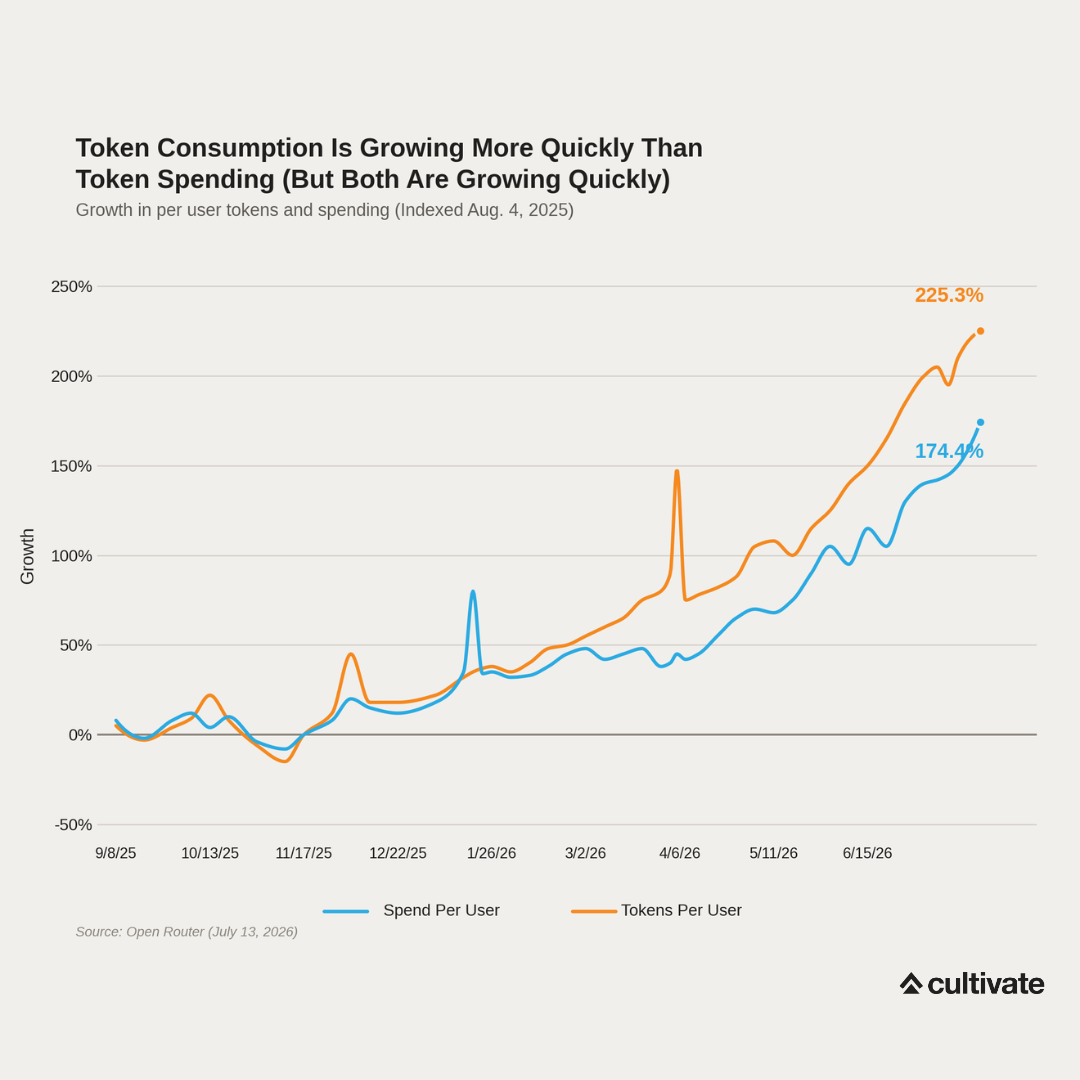
A year ago, tokens were not part of anyone’s budget plan. Now CFOs compare them to headcount. CNBC reported in May that roughly 95 percent of enterprise AI still runs on the priciest frontier models even for simple tasks, and Glean CEO Arvind Jain told the network that some companies exhaust an annual AI budget “in one month or two months.” On the All-In Podcast, the investor Chamath Palihapitiya said token costs at one of his companies were doubling every 45 days while measured productivity gains held near 5 percent.
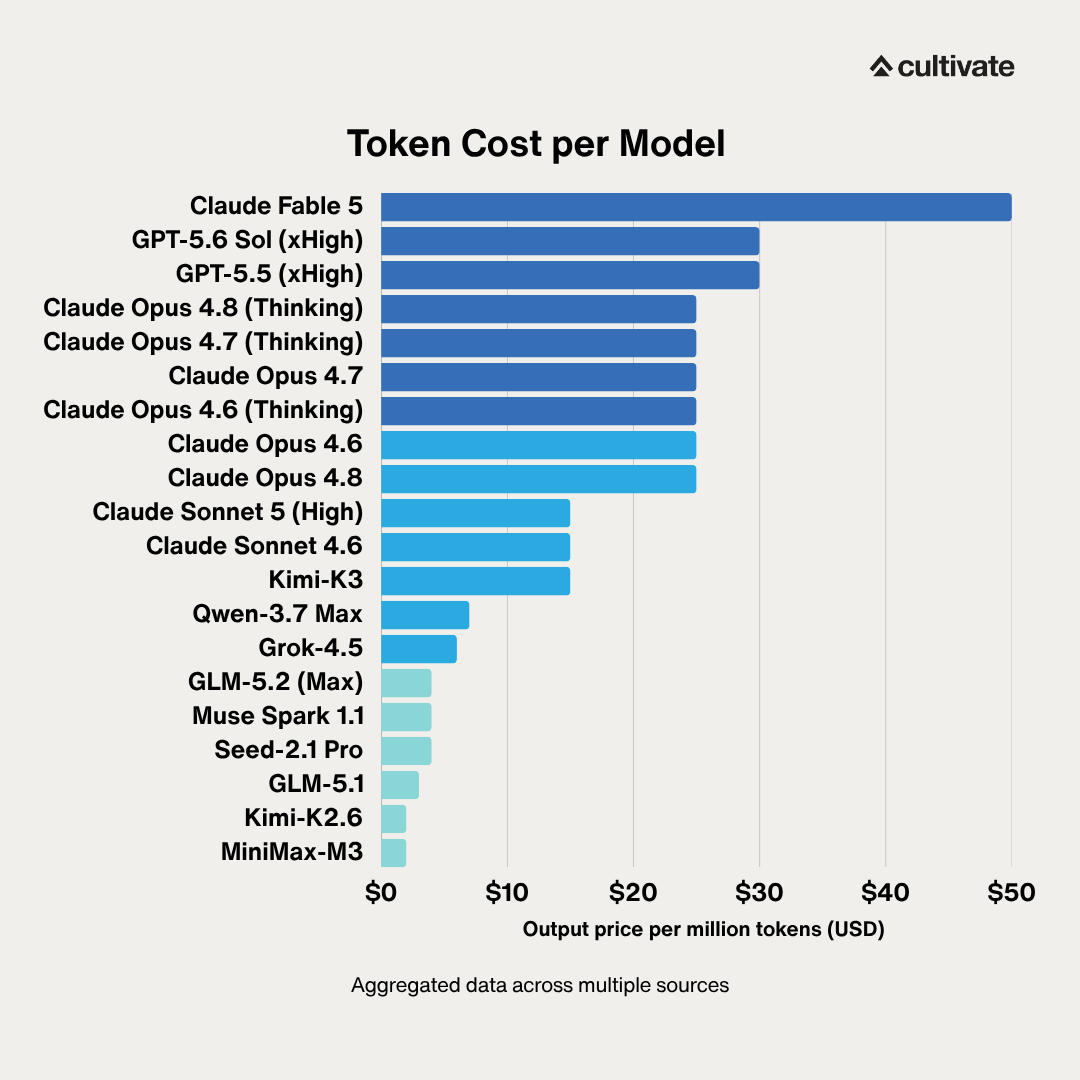
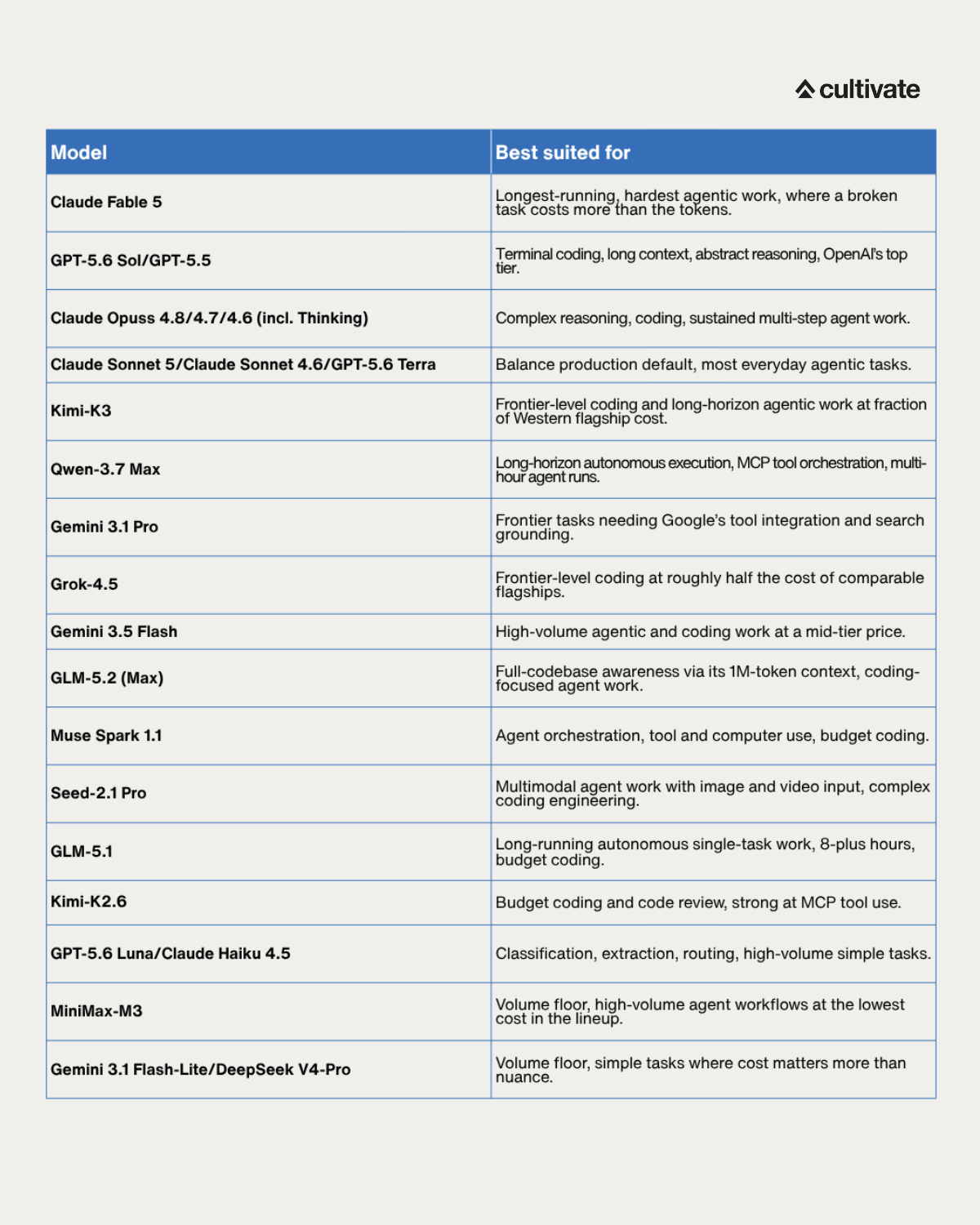
The price spread between models is wide enough to change behavior. On current rate cards, Claude Fable 5, Anthropic’s most capable model, runs $50 per million output tokens against $2.40 for MiniMax-M3, one of the cheapest open alternatives, a gap of roughly twenty times.
One caution when comparing rate cards: models differ in how many tokens they burn to produce an answer, so the honest comparison is cost per completed task, not price per million tokens. On that measure, per Artificial Analysis, a Kimi K3 task runs about $0.94 against $0.55 for OpenAI's efficient tier and $2.75 for Anthropic's top setup.
Kimi K3, for all of this week’s headlines, sits in the middle of that chart at $15. The pricier models also hold far more in memory at once, which is part of what the premium buys.
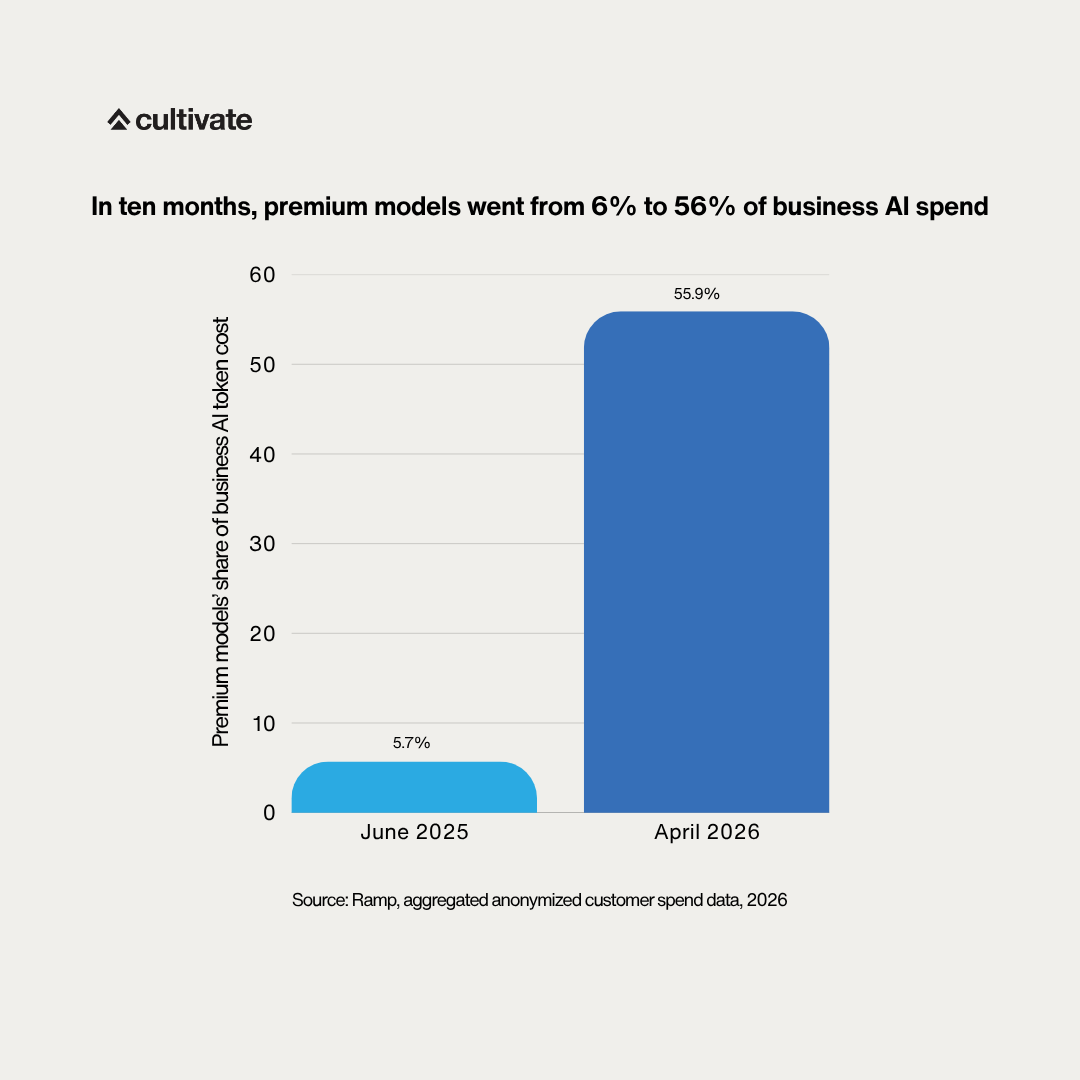
Defaulting upward is the norm, not the exception. Ramp, which tracks anonymized spending across its business customers, found premium models’ share of business AI cost climbed from 5.7 percent in June 2025 to 55.9 percent in April 2026, and that most finance teams never set a policy on which tiers their people may use. The habit has a name now. Factory AI CEO Matan Grinberg calls the result “the token hangover,” CIOs waking up to bills they cannot justify.
For anyone dealing with the same issues, his recommendation is to reserve the premium models for the 10 to 20 percent of work that needs deep reasoning and let cheaper models handle the rest.
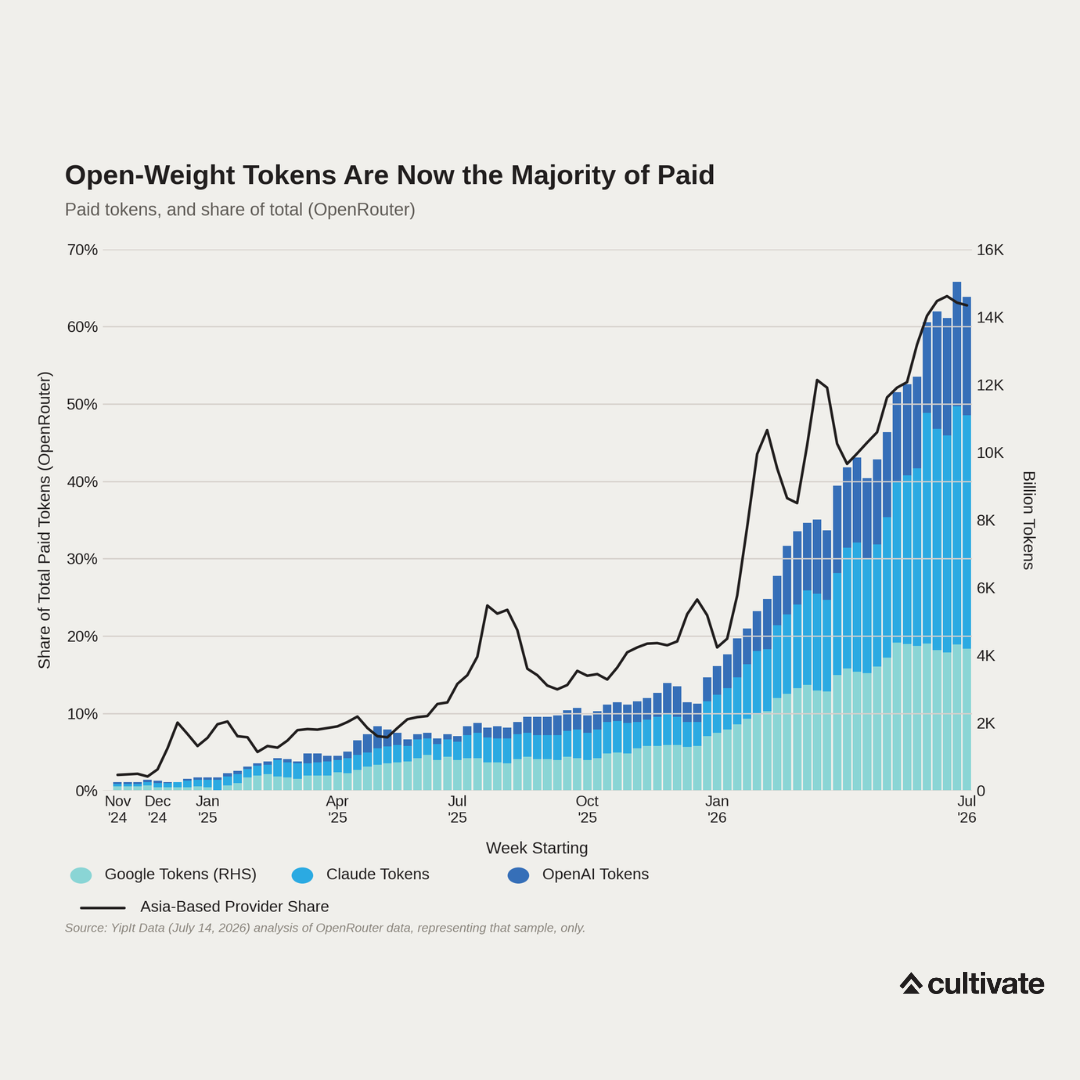
The rebalancing has already started in the aggregate numbers. On OpenRouter, a marketplace that routes business AI traffic across hundreds of models, the top five models by token consumption are now all open models from China, and roughly 45 percent of all tracked tokens flow through Chinese models. The Wall Street Journal’s Christopher Mims reports that customers are reassessing which premium models they truly need, and that OpenAI and Anthropic are weighing a price war the open models have in effect already started.
His line about Murati's new open model captures the question companies are starting to ask: "Who needs an AI Ferrari to get to work when the AI Honda Civic is right there?"
There are two ways to get the choice wrong. Send routine work to the expensive model and you pay for power you do not need. Hand an open problem to a quick model and you get a tidy answer to a question nobody worked out first. Wharton’s Ethan Mollick has flagged a third failure, and this one is from the software that picks models automatically.
Routers, he says, “underestimate the difficulty of non-math/coding tasks” and hand them too little intelligence, which means the hardest-to-verify work (innovation, marketing, qualitative judgment) is often what gets shortchanged.
The work your talent, learning and culture teams do sits squarely in that category.
The choice comes down to which mode you’re in
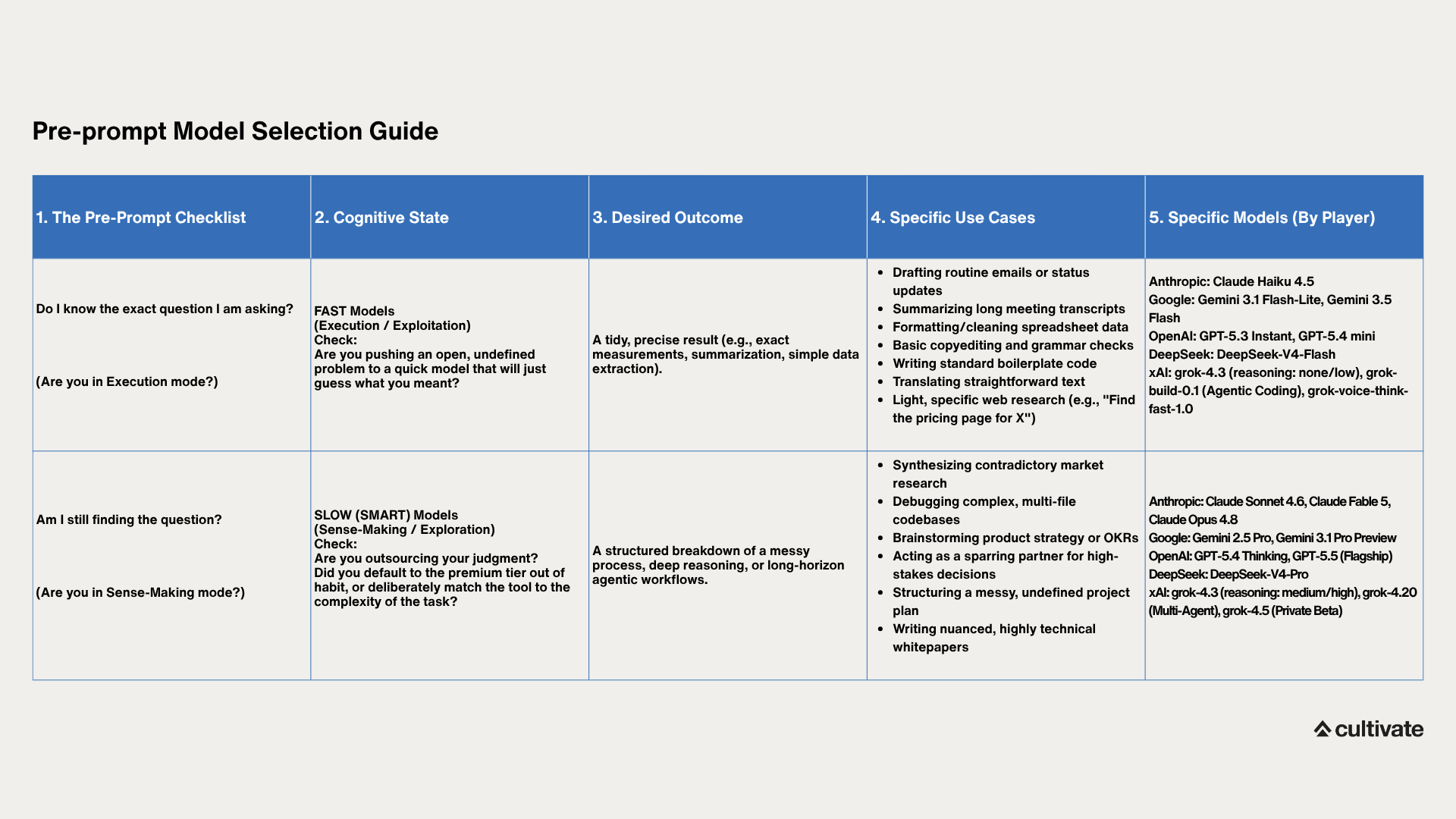
In execution mode, you know the question and the path is clear, so you want a result, like a floor plan with exact measurements.
In sense-making mode, you have a direction you cannot yet put into words, so you want help thinking it through, like bringing order to a messy process.
Scientists will recognize the split at a glance. One mode runs the protocol, the other designs the experiment.
Researchers at the University of Helsinki watched 25 doctoral students work with a language model and saw the same two patterns, which they label exploitation and exploration. The trouble starts when a person’s thinking is in one mode and their tool is set for the other.
If you already know the question and want a clean, specific result (a summary, an extraction, a set of numbers in the right format), reach for the fast tier: Claude Haiku 4.5, Gemini 3.5 Flash, GPT-5.4 mini, DeepSeek-V4-Flash, grok-4.3 on low reasoning.
The pre-prompt check for this mode: are you pushing an open, half-formed problem to a quick model and hoping it guesses what you meant?
If you are still finding the question and want help breaking a messy situation down rather than a neat answer to something you have not framed yet, reach for the stronger tier: Claude Sonnet 4.6 or Opus 4.8, Claude Fable 5, Gemini 3.1 Pro, GPT-5.5, DeepSeek-V4-Pro, grok-4.3 on high reasoning.
The pre-prompt check here: did you choose this tier on purpose, or reach for it out of habit?
Two prompts to test the difference
Execution mode. “Summarize the attached transcript into five bullet points, each under fifteen words, grouped by decision, owner and deadline.” You know exactly what you want back, so a fast model is the right call.
Sense-making mode. “I lead a team of eight, and two strong performers keep clashing in reviews. Before you suggest anything, tell me what you would need to know, then reason through what might be going on.” You are handing over a direction, not a spec, so a stronger model earns its cost.
We ran both prompts through a fast model and a strong one; the pattern is below.
Box CEO Aaron Levie expects cheaper AI to increase demand even for the most expensive models, for a reason that will sound very familiar:
"You often need the strongest model possible for the orchestration of a task, then you can farm out work to cheaper or more tuned models for the bulk of tokens."
The routing pattern engineers are building into software is the same one your people need in their heads. The strongest thinking on framing the task, the cheaper effort on the bulk of the work.
What the modes look like in practice
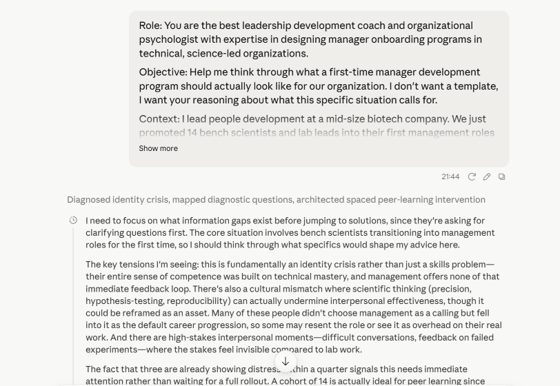
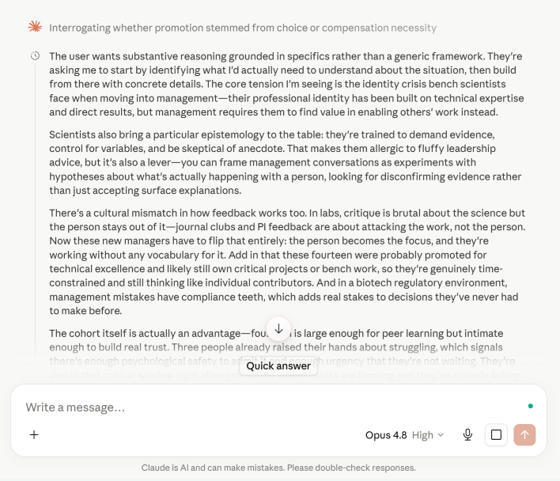
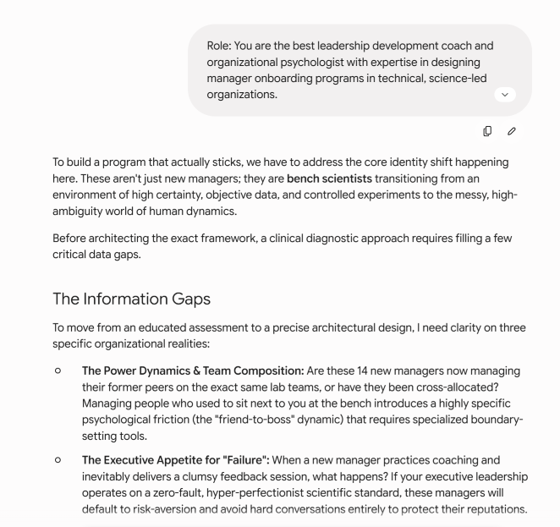
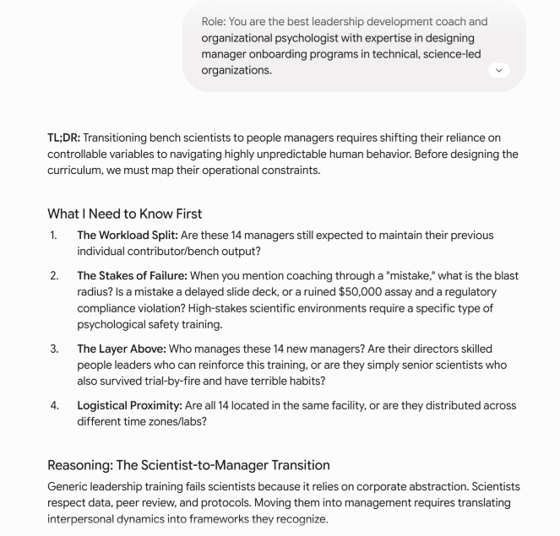
To see the difference for ourselves, we sent the same prompt to the fast and strong tiers of three model families using a scenario that we're familiar with in our work here at Cultivate.
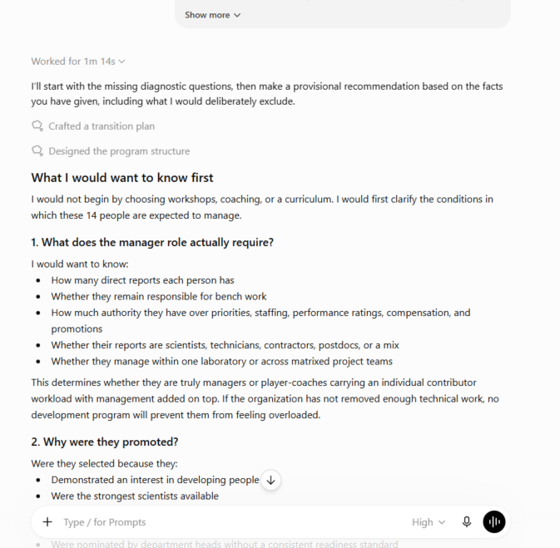
Here's the situation we gave each model: a people-development lead at a mid-size biotech, fourteen bench scientists just promoted into management, budget approved, but no fixed idea yet of what the program should actually look like.
The prompt
Role: You are the best leadership development coach and organizational psychologist with expertise in designing manager onboarding programs in technical, science-led organizations.
Objective: Help me think through what a first-time manager development program should actually look like for our organization. I don’t want a template, I want your reasoning about what this specific situation calls for.
Context: I lead people development at a mid-size biotech company. We just promoted 14 bench scientists and lab leads into their first management roles this quarter. Our current new-manager onboarding is a two-hour slide deck on performance reviews and a one-page HR systems guide. Three of these new managers have already told HR they feel out of their depth, not on the science, on the interpersonal side, giving feedback, having hard conversations, coaching a direct report through a mistake. We have budget approved for a real program. We do not yet have a fixed idea of format, length or delivery method.
Key parameters: Before proposing a solution, tell me what you would want to know that I haven’t told you yet. Do not default to a generic leadership curriculum; reason from what’s specific about this situation, technical experts moving into people management for the first time. There is no fixed format constraint (workshops, coaching, cohort-based peer learning or something else entirely), so use your judgment on what actually fits.
Claude: Sonnet 5 (fast) vs. Opus 4.8 (strong)
Claude: Sonnet 5 (fast)
Claude: Opus 4.8 (strong)
Gemini: 3.5 Flash (fast) vs. 3.1 Pro (strong)
Gemini 3.5 Flash (fast):
Gemini 3.1 Pro (strong):
ChatGPT: 5.5 Instant (fast) vs. 5.6 Sol (strong)
GPT-5.5 Instant (fast)
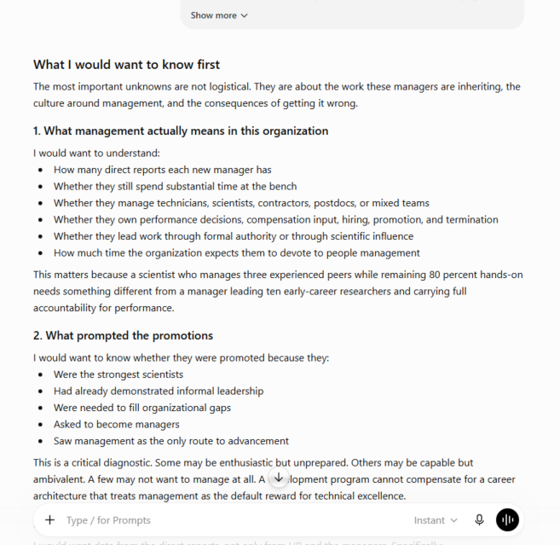
GPT-5.6 Sol (strong)
What we noticed.
All six answers are competent, which is precisely the trap. The difference is in the questions.
The fast models ask tidy ones: how many direct reports, what format, what budget.
The smart models interrogate the situation: one notices that lab culture trains scientists to critique the work and never the person, and that management inverts this entirely; another asks whether a "mistake" here means a late slide deck or a ruined $50,000 assay with regulatory consequences; a third concludes that if the organization has not removed enough bench work, no development program will fix the overload. The fast tier designs a better program. The smart tier questions whether any program can work, which is a finding about the organization, not the curriculum.
Notice too that you need to know this domain to see the gap at all. And that is precisely the point, especially on hard-to-verify work, where your people's judgment is the only quality control there is.
As answers get cheap, judgment is the part worth protecting
The people worth the most are the ones who can tell when they have the question right. Wharton researchers frame slow, shallow AI adoption as a human matter more than a training gap. A survey of 1,200 employees tied surface-only AI use to thinner use over time, and to what the researchers call psychological debt, felt most by early-career workers, which is the group science-led companies keep promoting into their first big roles.
Satya Nadella made a related point this month at the level of the firm. Companies that lean on AI pay for intelligence twice, once in cash and again in the proprietary knowledge they have to reveal to make that intelligence useful. That leads him to one blunt operating principle.
"Do not weld your company to any single model."
There is an honest counterargument, and it's something worth considering as you form your own perspective about how this all connects to your operations. David Sacks notes that open models’ share of enterprise AI spending fell this year, from 19 percent to 11 percent. Brad Gerstner argues that set against a $200-an-hour consultant, the price gap between a cheap model and an expensive one is a rounding error. And Palo Alto Networks CEO Nikesh Arora points out that if token prices keep falling, the premium models may end up the cheaper option to run anyway.
The debate is live.
What none of these arguments dispute is that someone at your company is making a model choice dozens of times a day, mostly without noticing.
The teams with an edge will be the ones who still know which questions are worth asking, and who can tell when a fast answer is hiding an unfinished thought. The tools will handle more work each year. What they cannot do is decide what should be asked, and that part stays with your people.
At Cultivate, we sit with the people side of this shift. The science-led companies we partner with are running the same experiment DoorDash ran, most of them without the benchmark: scientists, analysts and first-time managers deciding dozens of times a day which model gets their thinking. Teaching people to notice which mode they are in before they spend the tokens is culture and learning work, not procurement. So here is the question we would put to you.
Does anyone at your company know, today, what share of your AI spend went to work that actually needed the most expensive model?
Key Takeaways:
The model an employee picks for a task is a cost decision, and most teams make it on autopilot, defaulting to the most expensive option instead of matching the model to the work in front of them.
The real choice comes down to which mode the person is in. If you already know the question and want a precise result, a fast model does the job. Being still in the middle of working out what you are asking is a signal to reach for a stronger model, where the extra cost pays off.
The work talent, learning and culture teams do is the most at risk of being under-served, because the software that routes tasks tends to hand non-technical, hard-to-verify work to too little intelligence.
As answers get cheaper, judgment becomes the part worth protecting. The teams with an edge will be the ones who still know which questions are worth asking, and who can tell when a fast answer is hiding an unfinished thought.
Teaching people to notice which mode they are in before they spend the tokens is culture and learning work, not procurement. The question that closes the piece: does anyone at your company know what share of its AI spend went to work that needed the most expensive model?
Resources:
[1] Reuters (July 17, 2026). “China’s Moonshot unveils world’s largest open AI model, closing in on US rivals.” Kimi K3 at 2.8 trillion parameters, the largest open-weight system; performance approaching Anthropic’s frontier; China’s open ecosystem narrowing the gap at sharply lower cost.
[2] Axios (July 16, 2026). “China’s open-weight Kimi model stuns AI world with frontier-level results.” Arena blind testing preferred K3 over every leading US model for front-end coding, including Fable 5 and GPT-5.6 Sol; weights ship July 27. Caveat carried into the article: results are hours old and early benchmarks can overstate real-world reliability.
https://www.axios.com/2026/07/16/moonshot-kimi-ai-china-model-openai-anthropic
[3] OpenRouter, Kimi K3 model page. Pricing at $3 per million input tokens and $15 per million output; 1,048,576-token context window; released July 15, 2026.
https://openrouter.ai/moonshotai/kimi-k3
[4] Gavin Baker on X (July 17, 2026). Kimi K3 as a potential inflection point, “net positive for essentially every other company in the world”; notes K3 runs more expensive than GPT-5.6 per Artificial Analysis.
https://x.com/GavinSBaker/status/2078110934740980193
[5] Tom’s Hardware / Apple (May 2026). Tim Cook confirmed Mac mini and Mac Studio shortages could last several months; demand driven by developers running local AI agents (OpenClaw) on high-memory configurations.
[6] TechCrunch / Thinking Machines (July 15, 2026). Thinking Machines released Inkling, a 975-billion-parameter open-weight mixture-of-experts model, positioned for customization rather than as the strongest overall model.
[7] Felix Rieseberg / How I AI, Lenny’s Newsletter (May 2026). The faster-versus-stronger rule of thumb: faster model for well-defined problems, stronger model when you do not yet know what you are asking for. Rieseberg led the development of Claude Cowork at Anthropic.
[8] DoorDash Engineering / Andy Fang on X (Dec 2025). “How we learned to trust our AI code reviewer at DoorDash.” DashBench replays 105 historical code changes; Fable 5 + Kimi K2.6 hybrid caught 65.2% of real problems vs. 53.6% for the all-Anthropic pairing, $3.81 vs. $3.91 per code change. Fang: “Better quality, cheaper cost.”
https://careersatdoordash.com/blog/how-we-learned-to-trust-our-ai-code-reviewer-at-doordash/
[9] Aravind Srinivas on X (2026). The durable value is a secure multi-model harness that handles “orchestration and model routing” rather than any single model.
https://x.com/AravSrinivas/status/2076006003238486207
[10] CNBC (May 29, 2026). “Tokens or humans? The new corporate trade-off.” Roughly 95% of enterprise AI still runs on the priciest frontier models even for simple tasks; Glean CEO Arvind Jain on annual AI budgets exhausted “in one month or two months.” Companion piece, June 5: “Model routing is a fix for AI overspending.”
https://www.cnbc.com/2026/05/29/-tokens-or-humans-the-new-corporate-trade-off.html
[11] All-In Podcast (July 2026). Chamath Palihapitiya: token costs doubling every 45 days at one of his companies against roughly 5% productivity gains. David Sacks: open-source share of enterprise AI spend fell from 19% to 11% this year. Brad Gerstner: against a $200-an-hour consultant, the price gap between models is a rounding error.
https://podcasts.apple.com/us/podcast/all-in-with-chamath-jason-sacks-friedberg/id1502871393
[12] Ramp (2026). Aggregated, anonymized customer spend data: premium models’ share of business AI token cost rose from 5.7% (June 2025) to 55.9% (April 2026); median business runs 9 models; premium reasoning models cost 10–20x budget models; most finance teams have no formal model-tier policy.
https://ramp.com/blog/ai-token-cost-for-businesses
[13] 20VC: Matan Grinberg, Factory AI (June 2026). “The token hangover”: CIOs waking up to bills they cannot justify; spend frontier tokens on the 10–20% of work requiring deep reasoning, run the rest on cheaper models.
https://open.spotify.com/episode/40R3ULhqI2XjfUqG27lU7O
[14] Wall Street Journal (July 17, 2026). Christopher Mims on the shift to open models: the top five models by token consumption on OpenRouter are now all open models from China, carrying roughly 45% of tracked tokens; OpenAI and Anthropic weighing a price war the open models have already started.
https://www.wsj.com/tech/ai/cheaper-ai-commodity-openai-anthropic-0111da73
[15] Ethan Mollick on X (June 2026). “All model routers underestimate the difficulty of non-math/coding tasks and assign them too little intelligence… non-verifiable tasks (innovation, marketing, qualitative analysis) often benefit the most from using ‘smarter’ AI models.”
https://x.com/emollick/status/2071265352294584824
[16] npj Science of Learning (Nature) (June 2025). Study of 25 doctoral students showing human-LLM interaction splits into exploration and exploitation patterns. Peer-reviewed, University of Helsinki.
https://www.nature.com/articles/s41539-025-00332-3
[17] Knowledge at Wharton (April 2026). “AI Adoption Is a Challenge. Here’s a Solution.” Frames slow adoption as mostly a human and psychological problem rather than a training deficit.
https://knowledge.wharton.upenn.edu/article/ai-adoption-is-a-challenge-heres-a-solution/
[18] Harvard Business Review (May 2026). “The Psychological Costs of Adopting AI.” Survey of 1,200 employees; surface-only AI use tied to thinner use over time; researchers coin “psychological debt”; early-career workers most affected.
https://hbr.org/2026/05/the-psychological-costs-of-adopting-ai
[19] Satya Nadella, “The Reverse Information Paradox” (X, July 12, 2026). Firms using AI pay twice, “once with money, and again with… the proprietary knowledge you must reveal to make that intelligence useful”; operating principles include decoupling orchestration from any single model.
[20] Nikesh Arora on X (July 2026). Counterpoint on the economics: if token prices fall, it may be cheaper to run frontier models than open-source ones on your own GPUs; most enterprise use cases today are single-shot and semi-deterministic.
[21] Artificial Analysis (July 2026). Independent AI benchmarking firm. Intelligence Index v4.1 and cost per Index task: Kimi K3 ~$0.94, GPT-5.6 Terra ~$0.55, GPT-5.6 Sol ~$1.04, Claude Opus 4.8 ~$1.80, Claude Fable 5 (with fallback) ~$2.75. https://artificialanalysis.ai
[22] Aaron Levie on X (July 17, 2026). Box CEO, replying to Gavin Baker: "You often need the strongest model possible for the orchestration of a task, then you can farm out work to cheaper or more tuned models for the bulk of tokens." https://x.com/levie